In short
Microsoft Teams live events retired in 2026, pushing internal communications to Teams Town Halls. To prove the ROI of these broadcasts, you must look beyond native viewer counts and measure true reach across both live and on-demand audiences.
Key takeaways
- Teams live events retired on June 30, 2026, making Teams Town Halls the new standard for large-scale internal broadcasts.
- Native Teams analytics provide basic attendance for events with up to 3,000 attendees, but lack role and department segmentation.
- Employees who feel their voice is heard are more likely to perform at their best, proving the ROI of interactive town halls
- Measuring true reach requires combining live attendance with on-demand recording views to capture your full global workforce.
The shift from Live Events to Teams Town Halls
The digital workplace landscape experienced a major structural transition as Microsoft retired Teams live events on June 30, 2026, consolidating enterprise broadcasting into the updated Teams Town Hall experience[1]. For internal communication leaders, this migration is far more than a technical upgrade. It represents a timely opportunity to re-evaluate how leadership broadcasts connect with distributed workforces.
The timing of this shift coincides with a growing engagement deficit across enterprise organisations. Gallup research shows that U.S. employee engagement dropped to 31% in 2024, matching its lowest point in a decade[2]. When less than a third of your workforce feels actively connected to organisational goals, executive town halls can no longer serve as simple top-down announcements. You need clear visibility into whether your strategic messaging actually reaches employees across every office and department.
- Establish baseline attendance targets across key business units before and after major broadcasts.
- Measure post-event sentiment and content retention to ensure executive clarity.
- Transition from passive view counts to active audience participation tracking.
By treating the move to Teams Town Halls as a strategic reset, you can replace basic attendance lists with data-driven insights that demonstrate the direct business impact of your internal communication programs.
Where native Teams analytics fall short
Microsoft Teams provides built-in event reporting that gives organisers immediate feedback during live broadcasts. Real-time organiser analytics display viewer counts, attendees’ country or region, and viewing experience quality, and Microsoft documents this as an advanced feature available in events with up to 3,000 attendees unless your organisation adds attendee capacity packs[3]. While these metrics help IT managers verify stream stability, they leave critical communication questions unanswered.
| Capability | Native Teams Town Hall Insights | Strategic Internal Communication Analytics |
|---|---|---|
| Real-time Viewer Counts | Available for events up to 3,000 attendees | Available across all audience sizes |
| HRIS Demographic Filtering | Limited to Azure AD object IDs and tenant status | Full breakdown by department, role, and tenure |
| Cross-Channel Unification | Isolated to single event instances | Unified across SharePoint, Viva Engage, and Email |
| Longitudinal Trend Analysis | CSV export retained up to 28 days | Multi-year trend tracking and benchmark analysis |
| Executive-Ready Reporting | Raw CSV data tables | Automated ROI reporting templates and API integrations |
When executive leadership asks whether an all-hands meeting successfully reached front-line staff or remote regional teams, raw attendee counts fall short. Native logs show how many connections occurred, but they cannot tell you if your priority business units engaged with the content or if employees dropped off early. Relying solely on basic exports leaves a substantial reporting gap when evaluating specialised measurement tools.
To prove the return on investment of your town hall strategy, you must look past simple view tallies and measure true audience penetration across your organisation.
Measuring true reach: Live vs. On-Demand
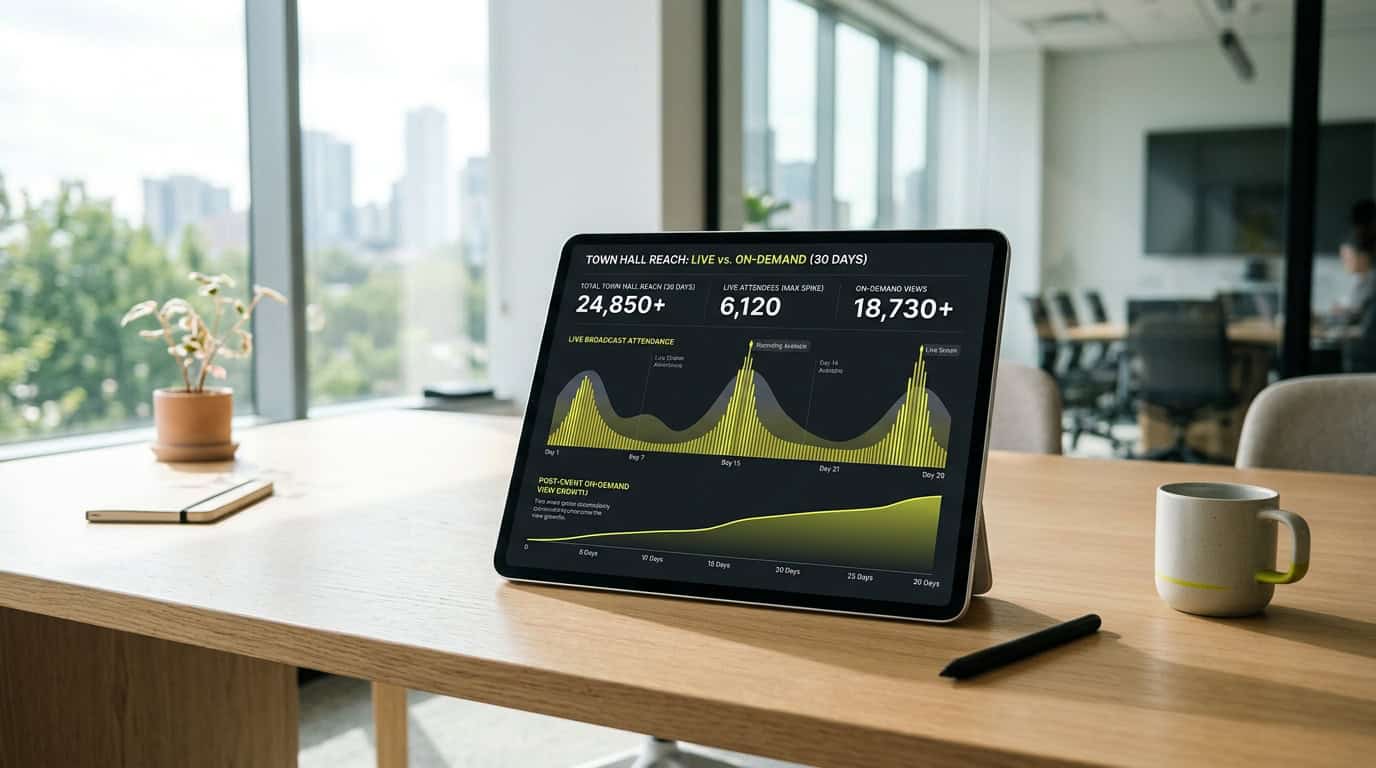
Modern hybrid work environments require employees to navigate competing schedules, time zone differences, and operational demands. Expecting every employee to attend an executive event live is unrealistic. A comprehensive reach calculation must evaluate both real-time broadcast viewers and post-event recording consumption over time.
An employee who watches a town hall recording two days after the live stream provides equal strategic value to an live attendee. Excluding on-demand viewership from your communication metrics underreports your actual reach, particularly among global workers and deskless teams who rely on video archives across Microsoft Stream and Viva Engage.
Tracking viewer retention across both live and recorded sessions helps you identify when audience drop-off occurs. If viewership declines significantly after twenty minutes, you can adjust future event agendas to deliver core strategic messages earlier in the program.
Segmenting your audience for actionable insights
Aggregated attendance figures often obscure critical communication blind spots. A town hall that attracts several thousand total viewers might appear successful, but if the vast majority of those attendees belong to headquarters staff while regional operational teams remain absent, the broadcast has missed its primary objective.
By connecting event attendance data with organisational HRIS attributes, you transform raw viewer logs into actionable intelligence. Segmenting your audience allows you to evaluate engagement across multiple key dimensions:
- Department and Business Unit: Verify whether engineering, sales, or customer support teams are actively participating.
- Geographic Region and Country: Identify regional offices that may experience language barriers or scheduling conflicts.
- Role and Seniority Level: Assess whether middle managers are tuning in to align their teams with executive priorities.
- Employment Type: Compare engagement levels between office-based staff and frontline workers.
Implementing detailed audience segmentation eliminates reliance on vanity metrics. You can clearly identify which employee groups require targeted follow-up communication, ensuring no critical segment is left out of key strategic updates.
The ROI of two-way engagement and production
High-performing internal communication strategies depend on genuine two-way dialogue rather than passive information delivery. Measuring attendee interaction during a town hall provides valuable insight into workplace sentiment and executive alignment.
Creating channels for employee voice yields measurable organisational benefits. Published research indicates that employees who feel their voice is heard at work are 4.6 times more likely to perform at their best[4]. Tracking interaction metrics during executive events helps you assess whether employees feel empowered to participate.
- Q&A Participation Rates: Measure the volume, sentiment, and voting engagement on submitted questions.
- Live Polling Response Rates: Track real-time feedback on strategic initiatives during the broadcast.
- Interactive Chat Activity: Monitor audience reactions and discussion topics throughout the event.
Evaluating these engagement indicators alongside video drop-off points allows you to refine your production format. If audience interaction spikes during open Q&A sessions but drops during lengthy slide presentations, you can adapt your strategy to allocate more time to live leader dialogue.
Connecting town halls to the broader IC ecosystem
Executive town halls do not occur in isolation. They serve as anchor events within a broader internal communication ecosystem that includes intranet news articles, enterprise social discussions, and leadership email updates. Isolating town hall metrics from the rest of your digital workplace creates artificial data silos.
To gain a complete view of employee alignment, you must measure how town halls stimulate activity across other channels. A successful executive announcement should trigger follow-up reader engagement on your SharePoint intranet and spark active discussion within Viva Engage communities.
- SharePoint Intranet: Post-event recap articles, leadership blogs, and downloadable presentation slides.
- Viva Engage Communities: Executive Q&A threads, team discussion channels, and feedback polls.
- Teams Town Halls: Live video broadcasts, key presentations, and archived event recordings.
- Email Newsletters: Executive summaries, event invitations, and highlights digests.
By implementing an all-in-one platform like Communication Insights, you can unify broadcast analytics with intranet and social metrics. Establishing comprehensive internal communication analytics enables you to track cross-channel journeys and understand the total impact of your campaigns.
Proving your impact with longitudinal tracking
Single-event metrics offer a temporary snapshot, but proving the strategic value of internal communications requires longitudinal tracking over quarters and years. Sustained measurement across multiple town halls reveals performance trends that native Microsoft dashboards cannot capture over extended periods.
At Tryane, our mission is to empower internal communication leaders with cross-channel analytics that convert fragmented data into executive-ready insights. By tracking participation patterns over time, you can prove how your communications strategy drives employee alignment and organisational stability.
- Establish quarterly benchmark metrics for reach, live attendance, on-demand views, and Q&A participation.
- Correlate engagement trends with key business initiatives, leadership announcements, and organisational changes.
- Deliver executive-ready reporting dashboards to leadership during annual budget reviews to defend IC resources.
We run a 15-minute working session with Heads of Internal Communication where we review your current measurement stack, identify segmentation gaps, and demonstrate what cross-channel reporting looks like on your Microsoft 365 tenant. Schedule a working session with Jérémy to optimise your town hall analytics strategy.
Frequently asked questions
What replaced Microsoft Teams Live Events?
Teams live events retired on June 30, 2026, and were replaced by Microsoft Teams Town Halls. Town Halls offer a unified experience that integrates features like moderated Q&A and real-time analytics directly into the Teams Enterprise and Premium tiers.
What do native Teams town hall analytics measure?
Native town hall insights in Microsoft Teams provide high-level metrics like overall viewer count and attendees’ country for events with up to 3,000 attendees. However, they do not provide deep demographic segmentation by HRIS attributes like department or role.
Why should I measure on-demand town hall views?
In a hybrid workforce, live attendance only captures a fraction of your actual audience. Measuring on-demand recording views alongside live attendance gives you a complete picture of your true cross-channel reach, ensuring you accurately report your executive communications ROI.
How do interactive town halls impact employee performance?
Town halls are critical for strategic clarity. Research shows that employees who feel their voice is heard are more likely to perform at their best. Interactive formats with high production value help combat disengagement and align employees with your company’s mission
Does Tryane integrate with Microsoft Teams town halls?
Yes. Tryane’s all-in-one platform connects with your entire Microsoft 365 ecosystem. We sit on top of Teams, SharePoint, and Viva Engage to provide cross-channel reach and engagement views, combining native data with our own tracking layer to deliver executive-ready ROI reporting.
Sources
Further reading
• Measuring cross-channel internal communications
• Audience segmentation for internal communications
• The five internal communication KPIs that show your IC is working
• Measuring frontline worker communications
• How to prove internal communications works to leadership
• Building an internal communications measurement strategy
Tryane runs a 15-minute working session with Heads of Internal Communication, walking through your current measurement setup and showing where the segmentation gaps sit on your own Microsoft 365 tenant. Book a slot with Jérémy.