In short
C-suite leaders expect internal communications to deliver measurable business outcomes, not just page views. Discover how to move beyond native vanity metrics, connect cross-channel data to employee engagement, and build an executive-ready ROI reporting model.
Key takeaways
- 92% of internal comms leaders struggle to prove ROI to their executive team because they rely on fragmented vanity metrics.
- Highly engaged workforces yield concrete business results, driving up to a 19% increase in operating income.
- Poor internal communication costs companies an average of $12,506 per employee per year in lost productivity and execution failures.
- Tracking cross-channel analytics allows you to map segmented employee behaviour directly to strategic corporate KPIs.
The problem with native vanity metrics
Every Head of Internal Communication operating in a Microsoft 365 environment faces a familiar executive question during annual budget reviews: What is the ROI of internal comms? For years, internal communicators have relied on native platform analytics to demonstrate performance. However, traditional reporting metrics such as SharePoint page views, Viva Engage post impressions, and Outlook email open rates fall short when presenting to the executive board.
The limitations of native platform stats
Native analytics tools provide basic activity counts across isolated channels. SharePoint Site Analytics measures how many times a page was loaded, while Viva Engage displays community interaction tallies. While these counters confirm that technical delivery occurred, they do not verify whether the message reached the specific operational departments, frontline workers, or strategic regions for which it was intended.
Why executives dismiss vanity metrics
When communications teams present total page views or email open rates to executive leadership, the CFO and C-suite often remain unconvinced. Leadership regards simple reach numbers as vanity metrics because high page views do not correlate automatically with comprehension, alignment, or execution. An employee opening an email or scrolling past a SharePoint news banner does not mean they understood the message or adapted their daily behaviour.
The 92% reporting gap in internal communications
This disconnect between comms reporting and executive expectations is widespread across corporate organisations. According to a global research report by Workvivo, 92% of internal communications professionals admit they struggle to prove the ROI of their work[1]. Furthermore, 46% of IC leaders report that their metrics fail to resonate with executive leadership because standard vanity statistics do not connect to strategic business objectives[1].
| Metric Type | Native Vanity Metrics | Executive-Ready Strategic Metrics |
|---|---|---|
| Focus Area | Activity counts (clicks, views, opens) | Business outcomes (comprehension, retention, behaviour shift) |
| Scope | Single-channel, isolated tenant data | Cross-channel, aggregated workforce analytics |
| Audience Insight | Unsegmented totals across all employees | Granular breakdown by department, role, and location |
| Leadership Value | Dismissed as operational noise | Accepted as evidence for strategic ROI |
Connecting internal comms to business outcomes
To close the reporting gap and secure leadership trust, internal comms teams must transition from tracking communication outputs to measuring tangible business outcomes. Executive teams evaluate investments based on core business priorities: employee retention, operational productivity, organisational agility, and profitability.
Defining business outcomes versus comms outputs
Communication outputs describe what the IC team produces, such as publishing five intranet articles or sending a biweekly newsletter. In contrast, business outcomes represent the organisational impact of that communication, such as accelerated adoption of new operational procedures or improved employee retention rates. Demonstrating how internal campaigns support strategic priorities helps establish true business value in executive conversations.
The financial impact of high employee engagement
Effective internal communication serves as a primary driver of employee engagement, directly affecting corporate performance. Research conducted by Towers Watson demonstrates that companies with high employee engagement levels achieve a 19% improvement in operating income over a 12-month period, whereas organisations with low engagement experience a 33% decline[2]. Connecting communication reach to engagement metrics enables IC leaders to frame internal comms as an income driver rather than an administrative expense.
Quantifying the true cost of poor workplace communication
Beyond driving performance, effective internal communication prevents substantial financial waste. A comprehensive study by Grammarly and The Harris Poll revealed that ineffective workplace communication costs United States businesses an estimated $12,506 per employee per year in lost productivity and operational inefficiency[3]. Applied across a large enterprise workforce, miscommunication quickly represents millions of dollars in preventable losses every year.
- Employee Retention: Lowering turnover by keeping staff informed and connected to leadership strategy.
- Productivity & Efficiency: Reducing wasted time spent searching for critical policies or operational guidelines.
- Change Adoption Speed: Accelerating compliance and project execution during corporate transformations.
- Risk Mitigation: Confirming that crisis updates and regulatory notices reach every targeted operational unit.
Map your campaigns to specific corporate KPIs
Proving return on investment requires establishing strategic objectives before initiating communication campaigns. Rather than publishing updates reactively, communications teams must align each major campaign with active C-suite priorities and established key performance indicators.
Setting strategic goals before sending messages
Before publishing content across Microsoft 365 channels, clarify the specific outcome expected from the audience. Determine whether the campaign aims to increase policy compliance, drive enrolment in a new benefits program, or guide teams through an IT system migration. Setting clear pre-campaign targets creates measurable benchmarks for evaluation.
Aligning messaging with C-suite priorities
Executive leaders focus on overarching strategic pillars, such as digital transformation, corporate culture alignment, or operational cost control. Frame your internal communications agenda around these exact themes. When your quarterly communications strategy mirrors the CEO’s operational roadmap, reporting on campaign outcomes directly answers executive priorities.
Tracking behavioural shifts through data-driven decisions
Data-driven decision-making involves tracking employee action beyond the initial read. By evaluating campaign exposure alongside operational data, such as completion rates for compliance training or participation in strategic feedback surveys, you show that internal communication triggers measurable behavioural changes across the enterprise.
| Corporate Strategic Goal | Internal Comms Campaign Objective | Targeted Behavioural KPI |
|---|---|---|
| Digital Transformation | Drive adoption of new enterprise tools | Active usage rate across regional business units |
| Corporate Culture & Retention | Improve employee alignment and trust | Growth in cross-departmental engagement |
| Operational Compliance | Ensure mandatory policy sign-offs | Verified read rate in high-risk departments |
| Change Management | Support organisational restructuring | Completion rate of town hall Q&A pulse checks |
Segment your audience for deeper insights
Company-wide averages hide vital insights. A strong enterprise-wide read rate may appear successful, but that figure can easily conceal near-zero engagement within critical manufacturing plants or remote sales teams. Proving value to leadership requires granular audience segmentation.
Moving beyond company-wide averages
Relying on aggregate metrics creates a false sense of security. To understand how information flows across your organisation, IC leaders must cross-reference communication interaction data with employee demographic attributes, including department, job role, geographic location, and office model.
Identifying disconnected departments and digital noise
Granular segmentation highlights disconnected pockets of the workforce. For instance, detailed channel analytics may reveal that desk-based corporate staff engage heavily on SharePoint, while frontline operational units rely on mobile updates or Viva Engage posts. Identifying these patterns allows you to reduce digital noise by eliminating unnecessary email blasts and targeting messages to the specific channels each audience uses.
Showcasing targeted reach to the CFO
When presenting to executive leadership, segmented reporting proves that your team strategically manages workforce attention. Demonstrating what share of senior managers in key growth regions completed a critical briefing provides the CFO with actionable proof of targeted operational alignment.
- Departmental Breakdown: Comparing engagement rates between IT, Sales, HR, and Operations.
- Geographic Segmentation: Identifying adoption gaps across regional offices and international branches.
- Role & Level Filters: Tracking executive, managerial, and frontline staff readership separately.
- Tenure & Onboarding Cohorts: Measuring how newly hired employees engage with core cultural content.
Consolidate your data with cross-channel analytics
Modern enterprise communication relies on a multi-channel digital workplace. Employees receive updates through email newsletters, read announcements on SharePoint intranets, participate in community discussions on Viva Engage, and view announcements in Microsoft Teams. Tracking these channels independently creates data fragmentation.
The danger of data silos
Measuring each communication tool in isolation prevents you from capturing an employee’s total journey. When email open rates sit in Outlook, page views live in SharePoint, and social engagement resides in Viva Engage, IC managers spend days copying raw numbers into spreadsheets every month. This manual effort leads to human error and obscures overall workforce reach.
Unifying metrics with Communication Insights
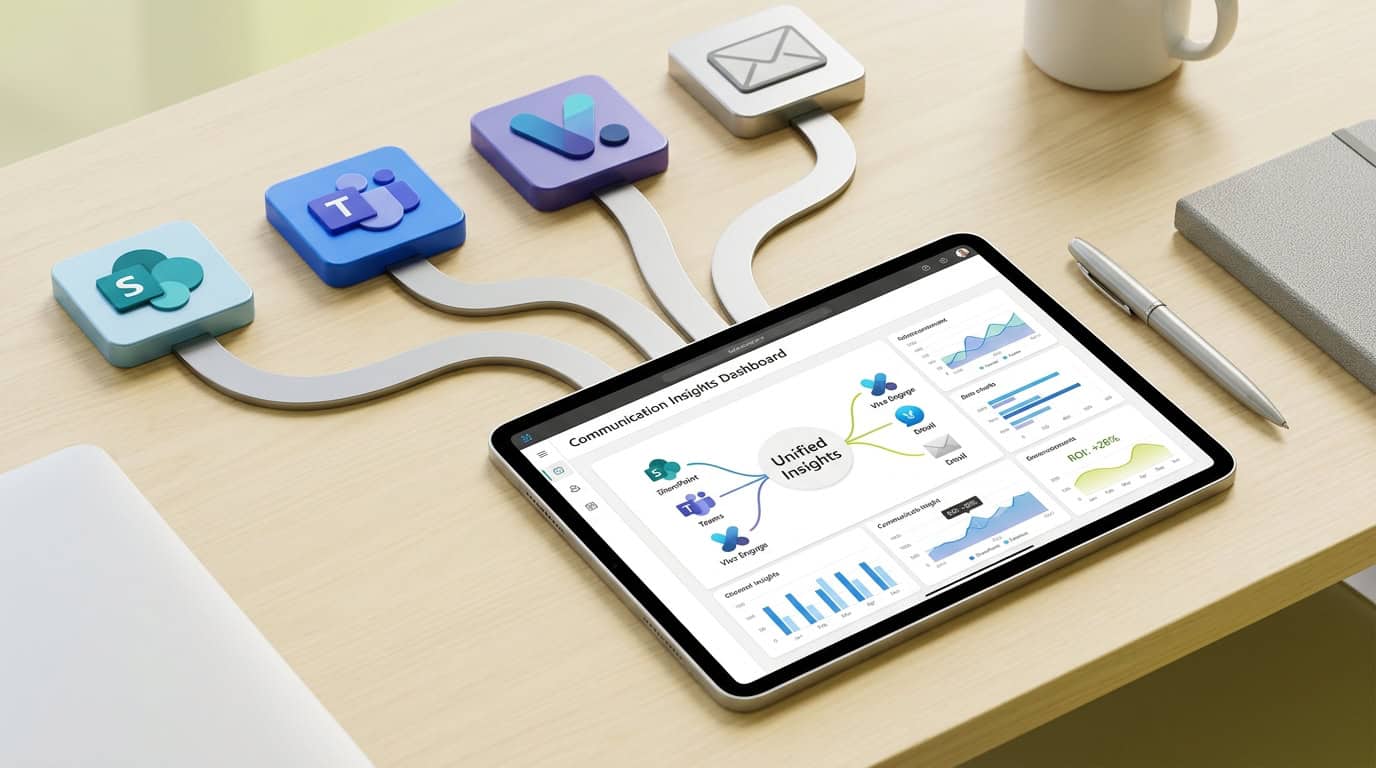
We at Tryane developed Communication Insights to solve data fragmentation. As an all-in-one cross-channel analytics platform, Communication Insights integrates data from SharePoint intranets, Viva Engage communities, Microsoft Teams, and email newsletters into a single dashboard. Together with dedicated solutions like Analytics for SharePoint and Analytics for Viva Engage, IC leaders gain holistic KPI analysis without manual data assembly.
Reducing manual reporting effort
Automating data collection across your entire Microsoft 365 environment transforms team efficiency. Instead of spending hours gathering numbers from disconnected administrative portals, your communications team can spend that time analysing trends, refining content strategies, and delivering strategic insights to leadership.
Build an executive-ready reporting dashboard
Presenting analytics to executive leadership requires a dedicated reporting format. The C-suite does not have time to review technical log files or twenty-page operational slide decks; executives need concise, visual, outcome-focused summaries that support strategic decision-making.
Structuring a narrative for the C-suite
Structure your executive presentation around clear business narratives. Start with the strategic objective, outline the campaign execution across channels, present the reach and engagement metrics, and conclude with the business outcome achieved. Framing data within a narrative structure makes your performance metrics relevant to board members.
Shifting from reach to comprehension and action
To present a compelling argument, guide leadership through a three-stage measurement continuum. Show how initial campaign reach progressed into employee comprehension, and demonstrate how that comprehension resulted in measurable workplace action. An executive deck built on this continuum converts communications reporting into a business performance report.
Visualizing data for executive review
Designing an effective executive dashboard requires clear data visualisation. Utilize high-level summary cards for primary KPIs, accompanied by demographic drill-downs that highlight positive trends and operational areas needing attention. Providing an executive report with clear visuals allows leadership to grasp organisational communication health instantly.
- Stage 1 – Reach: Verified cross-channel penetration across targeted workforce segments.
- Stage 2 – Comprehension: Content interaction time, survey feedback, and discussion depth.
- Stage 3 – Action: Adoption rates, policy compliance, and operational behaviour shifts.
Take action: Turn insights into continuous improvement
Proving internal communications ROI is not a one-time presentation for an annual budget review; it is an ongoing cycle of continuous measurement, strategic adjustment, and performance optimisation.
Treating measurement as a continuous cycle
Continuous measurement allows internal communications teams to operate with agility. By analysing performance trends weekly and monthly, you can identify high-performing content formats, optimise publishing schedules, and adjust channel distribution before launching your next campaign.
Adapting future internal campaigns
Data-driven insights empower you to stop wasting resources on ineffective channels or unread content types. Reallocate your time toward media formats and communication channels that demonstrate proven engagement among your target audience segments, ensuring continuous improvement in communication efficiency.
Transform your internal communications ROI with Tryane
Our mission at Tryane is to empower internal communication professionals with actionable insights and centralised analytics across the Microsoft 365 ecosystem. By shifting from vanity metrics to cross-channel outcome tracking, you can demonstrate strategic business value and secure executive support for your comms function. To see how our Communication Insights platform can elevate your executive reporting, schedule a personalised call on Jérémy’s Calendly today.
Frequently asked questions
Why are open rates and page views considered vanity metrics?
Metrics like basic open rates or SharePoint page views only show that content was delivered or clicked, not that it was understood or acted upon. Executives consider them vanity metrics because they do not map directly to business outcomes like productivity or retention.
What is the true cost of poor internal communication?
Poor communication limits employee alignment and execution. Research by Grammarly and The Harris Poll shows that it costs organisations an estimated $12,506 per employee per year, primarily through lost productivity, increased turnover, and corporate execution failures.
How does cross-channel analytics help prove ROI?
Cross-channel analytics breaks down data silos by aggregating engagement across email, SharePoint, and Viva Engage into one centralised dashboard. This holistic KPI analysis allows you to prove whether the right message reached the right segmented audience at the right time.
Can Tryane replace SharePoint native analytics?
No. Tryane sits on top of your existing tools. SharePoint continues to record its native data, while Tryane consumes this information and adds its own tracking layer. This provides cross-channel views and executive-ready dashboards that native tools cannot produce.
How do you measure the business impact of employee engagement?
You measure impact by correlating internal comms reach and comprehension metrics with broader operational data. For example, highly engaged workforces have been shown to drive a 19% increase in operating income and significant reductions in absenteeism.
What should an executive-ready ROI report include?
An executive-ready report shifts the focus from sheer volume to strategic impact. It should highlight cross-channel reach segmented by role or department, demonstrate behavioural changes driven by campaigns, and link these shifts directly to corporate KPIs.
Sources
Further reading
• Measuring cross-channel internal communications
• Audience segmentation for internal communications
• The five internal communication KPIs that show your IC is working
• Measuring frontline worker communications
• How to prove internal communications works to leadership
• Building an internal communications measurement strategy
Tryane runs a 15-minute working session with Heads of Internal Communication, walking through your current measurement setup and showing where the segmentation gaps sit on your own Microsoft 365 tenant. Book a slot with Jérémy.