In short
When upgrading internal communication analytics, securing works council approval is a critical step in Europe. This guide explains how to consult the French CSE, German Betriebsrat, and Dutch OR to deploy compliant, cross-channel measurement while building employee trust.
Key takeaways
- European labor laws require consultation before deploying analytics that can monitor employee behaviour.
- In Germany and the Netherlands, works councils have binding co-determination and approval rights over new technical tools.
- The French CSE must be consulted prior to introducing technologies in companies with at least 11 employees.
- Aggregating cross-channel reach data helps differentiate strategic communication measurement from individual surveillance.
- Proposing clear data parameters and joint governance structures accelerates successful works council negotiations.
Why analytics triggers works council review
As internal communications functions transition from simple post counts to comprehensive engagement measurement across platforms like SharePoint intranet and Microsoft Teams, legal requirements under European labor law come into focus. Moving beyond basic pageview counters to analyse reach across departments, locations, or employee groups introduces cross-channel data correlation. In many jurisdictions, labor representatives perceive this level of measurement as a capability for monitoring employee behaviour and evaluating individual work performance.
Under European legal frameworks, software tools that record, process, or aggregate user interaction data can be classified as technical monitoring systems. When deploying internal communication analytics, communication leaders must recognise that employee representative bodies hold formal rights to review the introduction of new technologies and measures affecting working conditions[1]. Bypassing these mandatory consultation procedures exposes the organisation to legal challenges, labor court disputes, and immediate court-ordered suspensions of tool deployment.
- Cross-channel identity correlation: Linking user activity across email newsletters, SharePoint news, and enterprise social networks using employee identifiers.
- HRIS attribute integration: Combining system usage logs with corporate directory data such as department, job tier, or geographic location.
- Activity timestamping: Tracking the timing and frequency of employee interactions across corporate digital workplace tools.
- Granular readership logs: Capturing individual reader interactions rather than strictly aggregated population metrics.
To establish a compliant deployment path, internal communication and IT leaders must engage works councils and employee representatives early in the planning phase. Presenting a clear architecture that emphasises data aggregation and privacy protection ensures that measurement objectives support organisational transparency without compromising employee trust.
Germany: Navigating the Betriebsrat
In Germany, the legal framework governing employee representative rights is among the most stringent in Europe. Under Section 87(1)(6) of the German Works Constitution Act (Betriebsverfassungsgesetz or BetrVG), the works council (Betriebsrat) possesses a mandatory co-determination right (Mitbestimmungsrecht) regarding the introduction and application of technical devices designed to monitor the behaviour or performance of employees.
The Federal Labour Court (Bundesarbeitsgericht) interprets this provision broadly. A software application triggers co-determination rights if it is technically capable of collecting behavioural or performance data, regardless of whether the employer intends to use the data for individual evaluation. Consequently, internal communications measurement software cannot be lawfully implemented through unilateral executive decision. Management must negotiate and execute a formal works agreement (Betriebsvereinbarung) with the Betriebsrat prior to platform activation.
| Agreement Element | Required Provision | Compliance Objective |
|---|---|---|
| Processing Purpose | Strict limitation to internal communication reach measurement | Prevents scope creep into performance tracking |
| Data Aggregation Level | Minimum group threshold enforcement for reporting views | Protects individual employee anonymity |
| Data Retention Window | Defined automated purge schedule for activity logs | Adheres to storage limitation principles |
| Access Control Policy | Restricted administrative roles based on duty necessity | Prevents unauthorized HR or managerial access |
Attempting to deploy communications measurement tools without prior Betriebsrat approval renders the installation legally invalid. The works council can secure a cease-and-desist injunction from the German labor courts, halting system operation until a formal works agreement is finalized.
France: The CSE consultation process
In France, social dialogue requirements are defined by the Labor Code (Code du travail). For companies with 50 or more employees, the Social and Economic Committee (Comité Social et Économique or CSE) must be formally informed and consulted regarding decisions that affect general company organisation, working conditions, and the introduction of new technologies[2].
Article L. 2312-8 of the Code du travail mandates that employers present a detailed information dossier to the CSE before implementing software tools that collect employee usage data. The consultation process requires a formal meeting where management presents the objective of the communications measurement tool, the nature of the data collected, and the safeguards implemented to protect employee privacy. The CSE must be granted sufficient time to review the documentation and issue an official opinion (avis) prior to deployment.
- Preparation of the Information Dossier: Compile technical architecture documents, data flow diagrams, and privacy assessment documentation.
- Formal Submission and Presentation: Deliver the dossier to CSE members and present the project during a scheduled committee session.
- Deliberation and Review Period: Allow the statutory timeframe for employee representatives to evaluate the submission and raise technical inquiries.
- Issuance of Formal Opinion: Receive the CSE’s official opinion, document addressed concerns, and record the outcome in official meeting minutes.
Failing to complete the CSE consultation process constitutes an offense of obstruction (délit d’entrave) under French labor law. Labor courts can order the immediate suspension of the platform deployment and impose daily financial penalties until full compliance is achieved.
The Netherlands: Securing OR approval
In the Netherlands, employee representation rights are governed by the Works Councils Act (Wet op de ondernemingsraden or WOR). Under Article 27(1)(l) of the WOR, the works council (Ondernemingsraad or OR) holds an explicit right of consent (instemmingsrecht) over any proposed employer decision to adopt, amend, or withdraw a scheme relating to employee tracking or monitoring systems (personeelsvolgsysteem).
Dutch regulatory guidance establishes that digital workplace software collecting individual interaction logs across corporate networks falls under the definition of a personeelsvolgsysteem. Consequently, employers cannot deploy internal communications measurement software without receiving written consent from the OR. Establishing a transparent measurement framework early in the procurement process helps demonstrate that data collection serves macro-level organisational goals rather than individual oversight.
| Jurisdiction | Governing Statute | Representative Body | Legal Requirement |
|---|---|---|---|
| Germany | BetrVG § 87 Abs. 1 Nr. 6 | Betriebsrat | Mandatory Co-Determination (Betriebsvereinbarung) |
| France | Code du travail Art. L. 2312-8 | Comité Social et Économique (CSE) | Mandatory Information and Consultation (Avis) |
| The Netherlands | WOR Artikel 27 Lid 1(l) | Ondernemingsraad (OR) | Explicit Right of Consent (Instemmingsrecht) |
If management proceeds with software deployment without obtaining OR consent, the works council can declare the deployment void within one month. The OR can subsequently petition the District Court (Kantonrechter) to compel the employer to cease system operation.
Differentiating engagement from surveillance
The primary friction point during labor representative reviews is the perceived overlap between engagement measurement and workplace surveillance. Internal communications teams require data to determine whether corporate strategy updates reach employees across distinct business units. Conversely, employee surveillance focuses on evaluating individual productivity, activity duration, or personal response times.
To align with General Data Protection Regulation (GDPR) standards, communications measurement must enforce the data minimisation principle set out in Article 5(1)(c), which limits personal data to what is necessary for the stated purpose[3]. Implementing structured audience segmentation ensures that usage data is automatically aggregated at organisational levels, preventing managers from inspecting individual reader profiles.
- Surveillance Indicators: Individual time-tracking, personal keystroke logging, user-level read receipts, and manager-facing individual activity feeds.
- Engagement Parameters: Departmental reach percentages, regional publication consumption rates, channel performance trends, and anonymized feedback rates.
- Privacy Controls: Automated pseudonymization of individual user tokens and mandatory suppression of small population cohorts.
- Data Ownership: Centralized communications governance without local managerial monitoring capabilities.
By presenting a clear separation between macro engagement analysis and individual performance monitoring, internal communication leaders can demonstrate that data collection respects employee privacy while delivering actionable organisational insights.
Negotiating analytics parameters
Securing approval from works councils requires defining technical constraints during formal negotiations. Rather than requesting open-ended data access, management should present a constrained data processing plan that hardcodes privacy protection into system parameters.
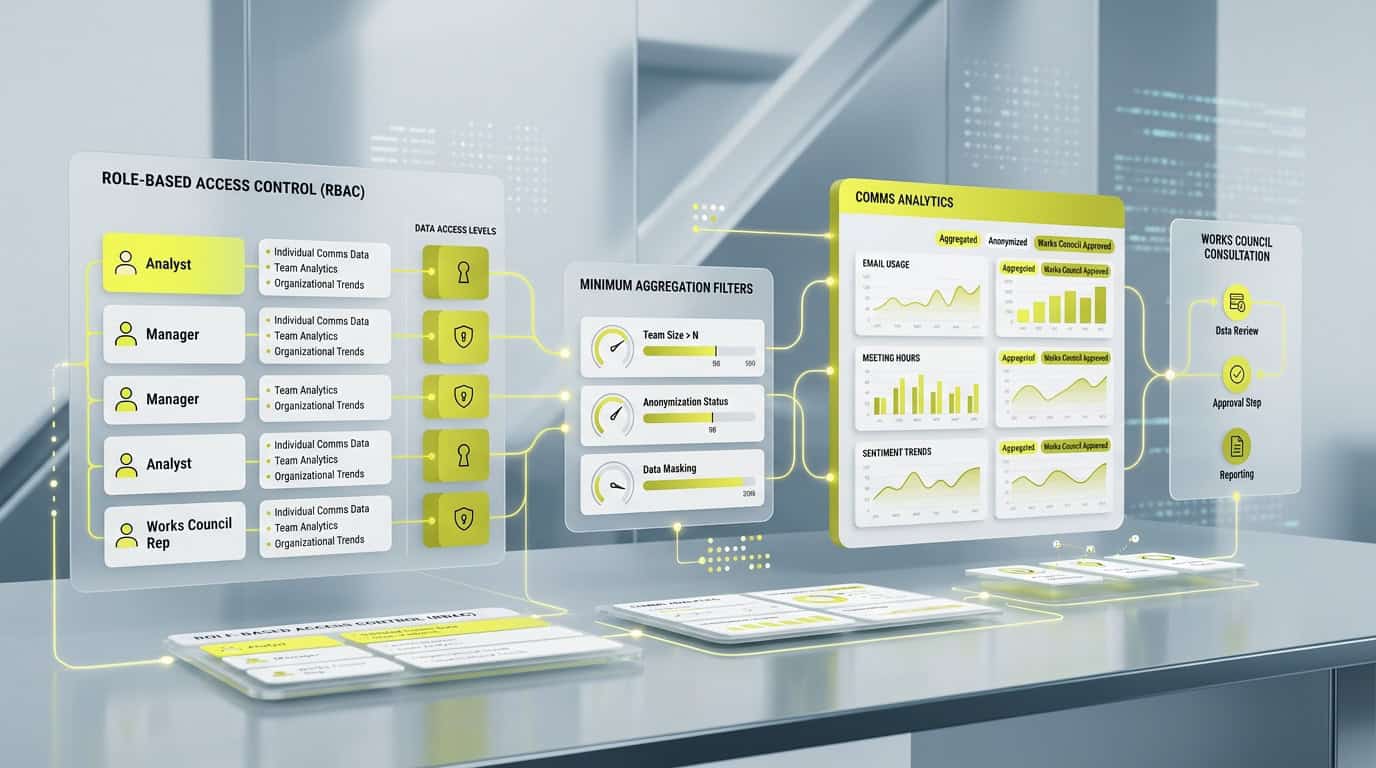
Key negotiation parameters include enforcing strict data retention windows, establishing role-based access control (RBAC), and setting minimum aggregation thresholds. Aligning these settings with organisational security and compliance standards demonstrates to employee representatives that administrative safeguards prevent improper data inspection.
Documenting these technical restrictions within the works agreement or CSE dossier provides legal certainty. When worker representatives see that technical controls physically prevent individual tracking, formal approval cycles progress significantly faster.
Building a collaborative governance model
Labor consultation should not be treated as a one-time transactional barrier. Establishing a collaborative governance framework ensures ongoing compliance and builds sustained trust between management, internal communications leads, and worker representatives.
Forming a joint monitoring committee allows representative bodies to review annual data processing practices and verify that platform usage remains within approved parameters. Dedicated solutions like Analytics for SharePoint and Analytics for Viva Engage provide transparent, cross-channel reporting engineered to support European workplace standards.
- Annual Governance Review: Conducting periodic audits of data access logs and reporting configurations with works council delegates.
- Protocol Modification Review: Submitting proposed analytics scope changes to the joint committee prior to implementation.
- Employee Transparency Reporting: Publishing clear explanatory notices to staff regarding what communications data is measured and how it is protected.
- System Auditing: Maintaining immutable administrative audit trails to verify compliance with signed works agreements.
We at Tryane specialise in helping global enterprises navigate cross-channel communications measurement within strict regulatory environments. Our solution, Communication Insights, provides executive-ready analytics with built-in privacy controls that satisfy European works council standards while eliminating data silos.
Tryane runs a 15-minute working session with Heads of Internal Communication to review your current measurement setup, address works council compliance, and demonstrate privacy-first reporting on your Microsoft 365 environment. Book a slot with Jérémy to schedule your working session.
Frequently asked questions
What is a works council in the European Union?
A works council is a statutory employee representative body that exists in most EU member states. It holds formal rights over management decisions that affect the workforce, including the introduction of monitoring technologies and new digital tools.
Why does internal communication analytics require works council consultation?
Advanced analytics tools track how employees interact with digital content across platforms. In many jurisdictions, this level of measurement qualifies as introducing a technical device designed to monitor employee behaviour, triggering mandatory labor law consultations.
What happens if we deploy analytics without works council approval in Germany?
Under BetrVG Section 87(1)(6), the Betriebsrat has binding co-determination rights over technical monitoring devices. Bypassing them is a substantive violation of labor law, allowing the works council to seek injunctive relief to block the deployment.
How does the French CSE differ from the German Betriebsrat?
The French Comité Social et Économique (CSE) is primarily consultative; employers must formally seek its opinion before deploying new technology. In contrast, the German Betriebsrat holds binding co-determination rights and must actively agree to the deployment.
Does GDPR compliance mean we can bypass works council consultation?
No. Data privacy compliance under the GDPR and labor law consultation requirements are two distinct legal obligations. Organisations must satisfy both frameworks independently before deploying measurement tools in countries like Germany and France.
How can we prove our analytics tool is not for employee surveillance?
Focus your negotiation on audience segmentation and aggregated cross-channel reach rather than individual user logs. Transparently outline your data retention policies, access limits, and anonymization methods to demonstrate that the tool measures communication impact, not individual performance.
What should be included in a works agreement for analytics?
A detailed works agreement (Betriebsvereinbarung) should clearly specify the scope of data collection, outline strict access controls, define data retention periods, and ideally establish a joint monitoring committee for ongoing oversight.
Sources
Further reading
• Measuring cross-channel internal communications
• Audience segmentation for internal communications
• The five internal communication KPIs that show your IC is working
• Measuring frontline worker communications
• How to prove internal communications works to leadership
• Building an internal communications measurement strategy
If you want to see what cross-channel reporting looks like against your real data, Tryane runs a 15-minute walkthrough with no slides. Book a slot with Jérémy.