
In short
Internal communication analytics process sensitive workforce data. With the average cost of a data breach hitting $4.88 million, IT teams demand rigorous SOC 2 Type 2 controls and strict EU data residency before approving any cross-channel measurement tool.
Key takeaways
- The average cost of a data breach is $4.88 million, making IC data security a board-level priority for IT.
- A SOC 2 Type 2 audit evaluates security controls over an observation period of 6 to 12 months, proving ongoing reliability.
- SOC 2 evaluates internal security controls but does not guarantee geographic data residency or GDPR compliance.
- Microsoft’s EU Data Boundary stores and processes customer data within the EU and EFTA regions to support European compliance.
Understand the Stakes of Internal Communications Security
As internal communications leaders, we routinely handle data that touches every corner of the enterprise. From corporate announcements and strategic alignment campaigns to employee sentiment and organisational updates, our platforms process sensitive workforce information every single day. In an era of heightened digital oversight, security is no longer an administrative detail left solely to IT departments. It is a critical concern for executive leadership, compliance teams, and CFOs alike.
When evaluating software for internal communication measurement, security cannot take a back seat. The financial and reputational consequences of compromised workforce data are staggering. According to the IBM Cost of a Data Breach Report 2024, the global average cost of a data breach reached $4.88 million[1]. Because internal communications tools ingest employee metadata, intranet activity logs, and cross-channel engagement records, any vulnerability in your measurement stack can expose your organisation to significant compliance and financial risks.
- Protection of employee personal identifying information across digital channels
- Mitigation of unauthorized data access and unapproved cloud storage
- Alignment with enterprise procurement standards and privacy frameworks
- Maintenance of trust between internal communication teams and executive stakeholders
Our mission is to empower internal communication professionals like you to deliver high-impact engagement without compromising data protection. Proving the value and return on investment of your communications strategy should never come at the expense of strict enterprise security.
Demystify SOC 2 Type 2 for IC Analytics
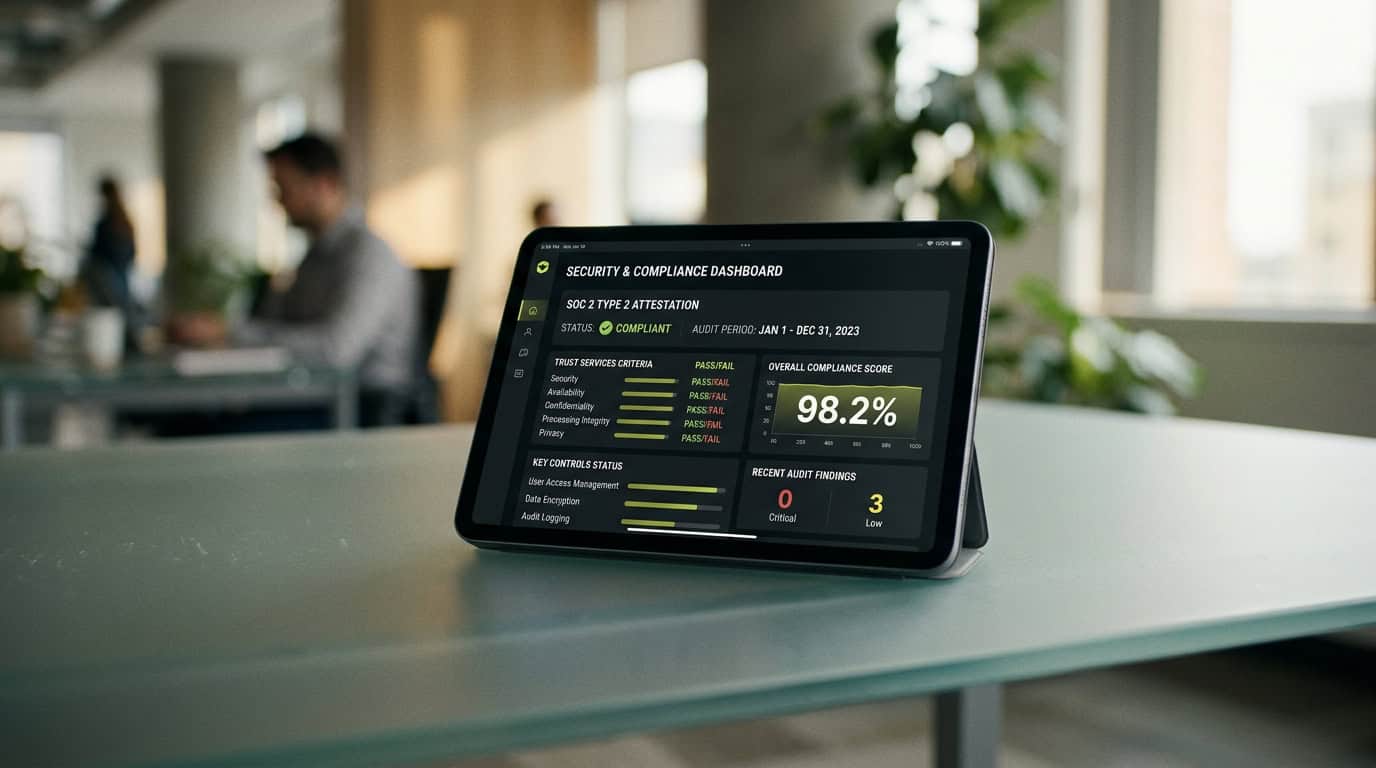
When reviewing security documentation for software solutions, you will frequently encounter SOC 2 compliance. Developed by the American Institute of Certified Public Accountants, SOC 2 evaluates how effectively a service organisation safeguards customer data based on Trust Services Criteria such as security, availability, and confidentiality. However, understanding the distinction between SOC 2 Type 1 and SOC 2 Type 2 is vital when choosing tools for your Microsoft 365 environment.
A SOC 2 Type 1 report assesses whether a vendor’s security controls are properly designed at a single point in time. In contrast, SOC 2 Type 2 evaluates the operational effectiveness of those controls across an observation period, typically six months for a first report and twelve months for subsequent audits[2]. This continuous evaluation ensures that security protocols are consistently enforced over time, rather than merely passing a snapshot audit.
| Audit Dimension | SOC 2 Type 1 | SOC 2 Type 2 |
|---|---|---|
| Audit Scope | Design suitability of security controls | Operational effectiveness of controls |
| Timeframe | Single point in time | Observation period, commonly 6 months for a first report and 12 months thereafter |
| Assurance Level | Initial structural validation | Continuous, long-term operational proof |
| Enterprise Preference | Basic vendor screening | Required for enterprise procurement |
For internal communications leaders reporting to C-suite executives, partnering with vendors that maintain SOC 2 Type 2 standards ensures that employee interaction data, engagement metrics, and administrative access logs remain protected under continuous, audited security controls.
Draw the Line Between Data Residency and Compliance
A common misconception in enterprise software evaluation is that achieving SOC 2 compliance automatically guarantees data residency. While SOC 2 verifies the presence and strength of security controls, it does not dictate the physical location where customer data is processed, stored, or backed up. Understanding this distinction is essential for organisations operating under strict legal frameworks.
Data residency refers to the specific geographic location where an organisation’s data resides. Data sovereignty is a broader idea: EU data protection rules apply across the European Economic Area, and when personal data is transferred outside that area, the European Commission notes that special safeguards are foreseen to ensure the protection travels with the data[3]. An analytics tool might hold robust security certifications while still processing employee data on infrastructure located outside your home region, potentially triggering compliance issues under international data transfer rules.
- SOC 2 Compliance: Focuses on security control design and operational effectiveness
- Data Residency: Specifies physical geographic boundaries for data storage and processing
- Data Sovereignty: Applies local privacy laws to stored data based on legal jurisdiction
- Cross-Border Risk: Transferring European employee data to non-EU servers requires explicit transfer mechanisms
To align with enterprise security standards, internal communications teams must confirm both security certification and physical data residency. Relying solely on SOC 2 without verifying server locations can leave your organisation vulnerable to regulatory scrutiny.
Maximize Microsoft 365 Security in the EU Data Boundary
Many enterprise organisations centre their digital workplace on Microsoft 365, utilising SharePoint Online, Viva Engage, Microsoft Teams, and Outlook to reach employees. To support European privacy standards, Microsoft established the EU Data Boundary, providing dedicated data residency for commercial and public sector customers in Europe.
The Microsoft EU Data Boundary is a geographically defined solution that stores and processes customer data and pseudonymized personal data for Microsoft’s core cloud services, including Microsoft 365, within the European Union and European Free Trade Association regions. Microsoft completed the boundary in February 2025, when professional services data from technical support interactions was also brought inside the EU and EFTA regions[4]. That commitment covers the workloads your intranet and employee communications run on, which is why native Microsoft 365 usage data stays inside European datacenters.
- In-Region Storage: Primary customer data and metadata remain inside EU and EFTA boundaries
- Pseudonymized Data Processing: Telemetry and user identifiers processed under strict European privacy controls
- Operational Residency: Technical support and administrative workflows aligned with regional compliance
- Enterprise Continuity: Built-in alignment with GDPR mandates for employee data protection
When expanding your measurement capabilities beyond standard native reporting, your internal communications tech stack must maintain these exact standards. Ingesting Microsoft 365 engagement data into external platforms requires software that respects the same geographic boundaries set by your primary operating system.
Identify the Cross-Channel Analytics Gap
Native reporting capabilities inside Microsoft 365 provide valuable baseline indicators, such as site visits in SharePoint or thread engagement in Viva Engage. However, these out-of-the-box dashboards operate in isolation. Internal communications teams often struggle to answer fundamental questions because native tools cannot merge data across email newsletters, intranet pages, and enterprise social networks.
To bridge this gap, organisations turn to dedicated analytics tools that centralise interaction metrics into a single dashboard. Longitudinal tracking allows teams to measure performance over time even as individual platforms evolve. Yet, adding a unified analytics layer introduces a crucial requirement: the external reporting engine must match the security and data residency standards of your core Microsoft 365 tenant.
| Capability | Native Microsoft 365 Reporting | Unified Analytics Layer |
|---|---|---|
| Channel Scope | Siloed per application (SharePoint, Viva Engage) | Centralized cross-channel measurement |
| Audience Filtering | Basic tenant-level statistics | HRIS attribute integration |
| Longitudinal Tracking | Limited historical retention | Multi-year longitudinal analytics |
| Executive Reporting | Manual spreadsheet consolidation | Automated cross-platform executive dashboards |
Connecting your digital workplace to a unified analytics platform should enhance your strategic reach without creating security vulnerabilities. Communicators need a solution that brings clarity to cross-channel engagement while upholding enterprise data governance.
Evaluate Vendor Subprocessors and Data Flows
When deploying third-party analytics software, the primary security risk often lies in third-party subprocessors. A vendor may host its primary servers within the EU, but if its secondary logging tools, artificial intelligence modules, or customer support platforms replicate employee data to external jurisdictions, your data residency guarantees are compromised.
Enterprise procurement and IT security teams require complete transparency regarding data flows. Under GDPR Article 28, a processor cannot engage another processor without prior specific or general written authorisation from the controller, the same data protection obligations must be imposed on that subprocessor by contract, and the processor must make available all information necessary to demonstrate compliance and allow for audits[5]. In practice that means asking for an up-to-date map of every subprocessor and its physical processing location, and confirming that backups, logs and disaster recovery replicas stay in the promised region.
- Where is primary customer data stored at rest?
- Are application logs or telemetry sent to subprocessors outside the EU?
- What legal transfer mechanisms (such as Standard Contractual Clauses) are in place?
- How is employee personal data pseudonymized before processing?
- Is single sign-on via Azure AD / Entra ID supported out of the box?
By addressing these questions during vendor selection, internal communications directors can partner effectively with IT procurement, ensuring that new analytics tools clear security reviews swiftly and maintain long-term compliance.
Secure Your Cross-Channel IC Insights with Tryane
At Tryane, we understand that internal communications leaders need clear, executive-ready metrics without compromising enterprise security. Our platform provides a unified analytics layer across SharePoint, Viva Engage, Teams, and internal newsletters, empowering you to break down data silos and demonstrate measurable impact to executive leadership.
We design our architecture with GDPR compliance by design and strict EU hosting, ensuring your employee interaction data remains protected within European data residency boundaries. Whether you deploy Communication Insights across your entire multi-channel strategy, implement Analytics for SharePoint to measure intranet reach, or utilise Analytics for Viva Engage to analyse community interactions, Tryane delivers robust insights anchored in strict enterprise security. By combining usage data with HR attributes, our platform enables granular audience segmentation while maintaining full data governance.
- Strict EU Hosting: All customer data resides on European cloud infrastructure
- GDPR Compliant by Design: Purpose-built data privacy controls for employee analytics
- Enterprise Authentication: Seamless SSO integration via Azure AD / Entra ID
- Cross-Channel Visibility: Centralized dashboards covering SharePoint, Viva Engage, Teams, and email newsletters
Ready to prove the value of your internal communications with a secure, EU-hosted analytics solution? Schedule a 15-minute Tryane demo with Jérémy to review your current measurement setup and discover how we can help you deliver actionable insights to your C-suite.
Frequently asked questions
What is the difference between SOC 2 Type 1 and Type 2?
A SOC 2 Type 1 audit assesses security controls at a single point in time. A SOC 2 Type 2 audit evaluates the effectiveness of those controls over an observation period of 6 to 12 months, offering stronger proof of ongoing security.
Does SOC 2 compliance guarantee data residency?
No. SOC 2 evaluates internal controls and security practices, but it does not mandate where data must physically reside. You must explicitly negotiate data residency and hosting locations to comply with regional laws like GDPR.
How much does an average data breach cost an organisation?
According to IBM research in 2024, the global average cost of a data breach reached $4.88 million. This escalating financial risk is why IT and procurement teams enforce strict compliance rules for internal communication platforms.
What is the Microsoft EU Data Boundary?
The Microsoft EU Data Boundary is a commitment to store and process customer data within the 27 European Union countries and the European Free Trade Association, ensuring sensitive information remains protected by local privacy laws.
Can cross-channel analytics tools break Microsoft 365 compliance?
Yes. If an analytics platform uses subprocessors that replicate data or logs outside of the approved geographic region, it can violate your organisation’s data residency requirements and compromise your Microsoft 365 compliance posture.
Why do internal communication teams need cross-channel analytics?
Native tools like SharePoint Site Analytics offer secure but siloed data. Cross-channel analytics unify data across SharePoint, Viva Engage, and newsletters to prove the ROI of communication efforts to executive leadership.
Where does Tryane host its internal communications data?
Tryane strictly enforces EU hosting to ensure data residency and is GDPR compliant by design. This ensures that European enterprises can safely analyse their Microsoft 365 communications without data leaving the designated region.
Sources
• ibm.com
• gdpr.eu
Further reading
• Measuring cross-channel internal communications
• Audience segmentation for internal communications
• The five internal communication KPIs that show your IC is working
• Measuring frontline worker communications
• How to prove internal communications works to leadership
• Building an internal communications measurement strategy
If you want to see what cross-channel reporting looks like against your real data, Tryane runs a 15-minute walkthrough with no slides. Book a slot with Jérémy.