
In short
Executives do not care about basic email open rates or intranet page views. To defend your internal communication budget, you must replace vanity metrics with cross-channel insights that prove your strategy drives alignment, compliance, and tangible business outcomes.
Key takeaways
- Over 92% of internal communications leaders struggle to prove the ROI of their work to executives.
- Nearly half (46%) of IC professionals admit their current reporting metrics fail to resonate with leadership.
- Vanity metrics like open rates must be replaced by segmented data on audience reach and message comprehension.
- True business impact is demonstrated by linking communication outcomes to strategic goals like compliance and change adoption.
The ROI challenge in internal communication
Every year, internal communication directors face a familiar turning point during annual budget reviews: defending their resources to executive leadership. While C-suite leaders acknowledge that workforce alignment is essential, proving the exact monetary value of internal communication remains notoriously difficult. In a global study of more than 5,200 communication professionals conducted by Workvivo by Zoom, 92% of respondents admitted they struggle to prove the ROI of their internal communications[1]. This credibility gap puts budgets at risk and leaves strategic initiatives vulnerable to arbitrary cuts.
The annual budget review and strategic credibility
When budget reviews arrive, executive committees look for clear connections between financial expenditure and business outcomes. When internal communication functions present basic distribution statistics instead of enterprise impact, leadership views the department as an administrative cost centre rather than a strategic value driver. Establishing a clear methodology for calculating the ROI of internal communications is not merely an academic exercise; it is essential for protecting your team’s funding, headcount, and influence.
The hidden cost of failing to prove impact
Failing to demonstrate outcome-based value forces communication teams into a reactive loop. Without hard evidence connecting campaigns to operational performance, communicators are expected to deliver more messages across more channels without receiving additional resources. Over time, this dynamic erodes leadership trust, reduces strategic influence, and obscures the real contribution internal communication makes to workforce stability and execution.
- Reliance on isolated channel metrics that quantify message distribution rather than workforce comprehension
- Lack of integration between internal communication platforms and enterprise HR demographic data
- Disconnect between communication objectives and broader organisational KPIs such as employee retention and policy compliance
Why vanity metrics fail to resonate with executives
For years, internal communication reporting has relied heavily on surface-level metrics like email open rates, intranet page views, and video play counts. However, executive leadership teams rarely care about distribution volume; they care about business results. In Workvivo’s global research, 46% of internal communications leaders said their reporting fails to resonate with executives, in part because vanity metrics like opens and clicks fall short of proving real business impact. Relying on vanity metrics obscures actual impact and signals to executive teams that reporting remains tactical rather than strategic.
The limitation of aggregate views
Aggregate figures provide a false sense of security. An intranet news post reporting a strong overall open rate can mask severe underlying communication gaps. That single average might reflect near-universal readership among corporate headquarters staff while only a small fraction of frontline operations or regional business units ever saw the message. When communicators present broad averages, executives recognise that key operational groups may be completely missing critical strategic updates.
Distinguishing activity from strategic impact
High activity does not automatically equate to high effectiveness. Publishing twenty articles a month or generating thousands of page views proves that your team is productive, but it does not prove that employees understood key messages or modified their behaviour. When re-evaluating which internal communication KPIs genuinely drive decisions, leadership requires evidence of comprehension, alignment, and operational execution rather than simple distribution totals.
| Communication Domain | Traditional Vanity Indicator | Executive Business Indicator |
|---|---|---|
| Email Campaigns | Open rate and total clicks | Segmented action completion and policy adoption |
| Intranet Content | Page views and hit counts | Departmental reach and active time spent on critical guidance |
| Enterprise Social | Likes, comments, and reaction volume | Cross-functional collaboration and leadership feedback loop |
Aligning communication data with business outcomes
To earn strategic recognition, internal communication measurement must shift from counting outputs to tracking outcomes. As communication strategist Jenni Field from Redefining Comms notes, traditional metrics measure engagement with communications rather than the business outcomes those communications are designed to achieve[2]. Moving beyond vanity metrics allows internal communication to function as a core business lever that drives strategic alignment, operational efficiency, and organisational resilience.
Connecting metrics to compliance and productivity
Internal communications directly influence key operational indicators, including safety protocol compliance, change management speed, cybersecurity compliance, and employee onboarding velocity. When a major corporate change or compliance policy is rolled out, tracking whether target employee groups adopt new workflows provides direct proof of communication value. By connecting campaign messaging to reduced operational errors and faster policy adoption, you transform communication data into recognised business value.
Translating IC data into executive language
Chief Financial Officers and Chief Executive Officers evaluate initiatives based on cost reduction, risk mitigation, and productivity gains. When reporting to the C-suite, internal communication leaders must translate campaign reach into those exact terms. Frame your communication performance around operational risk reduction, employee retention improvements, and executive alignment to secure a permanent seat at the strategic planning table.
- Policy Adoption Rate: Tracking how rapidly target employee groups acknowledge and adopt updated compliance standards
- Operational Safety Compliance: Connecting targeted messaging campaigns to reductions in workplace safety incidents
- Change Management Velocity: Measuring workforce responsiveness and system adoption during organisational transformations
- Workforce Retention Alignment: Evaluating the correlation between active leadership communication and reduced turnover
Measuring true reach through deep audience segmentation
Broad distribution numbers do not guarantee that critical messaging reached the specific teams responsible for execution. In Oak Engage research among 250 HR and internal communications professionals, 60% said they lack visibility into whether their communications are reaching or influencing employees[3]. Overcoming this blind spot requires combining communication activity data with rich organisational metadata to achieve precise audience segmentation across every tier of the workforce.
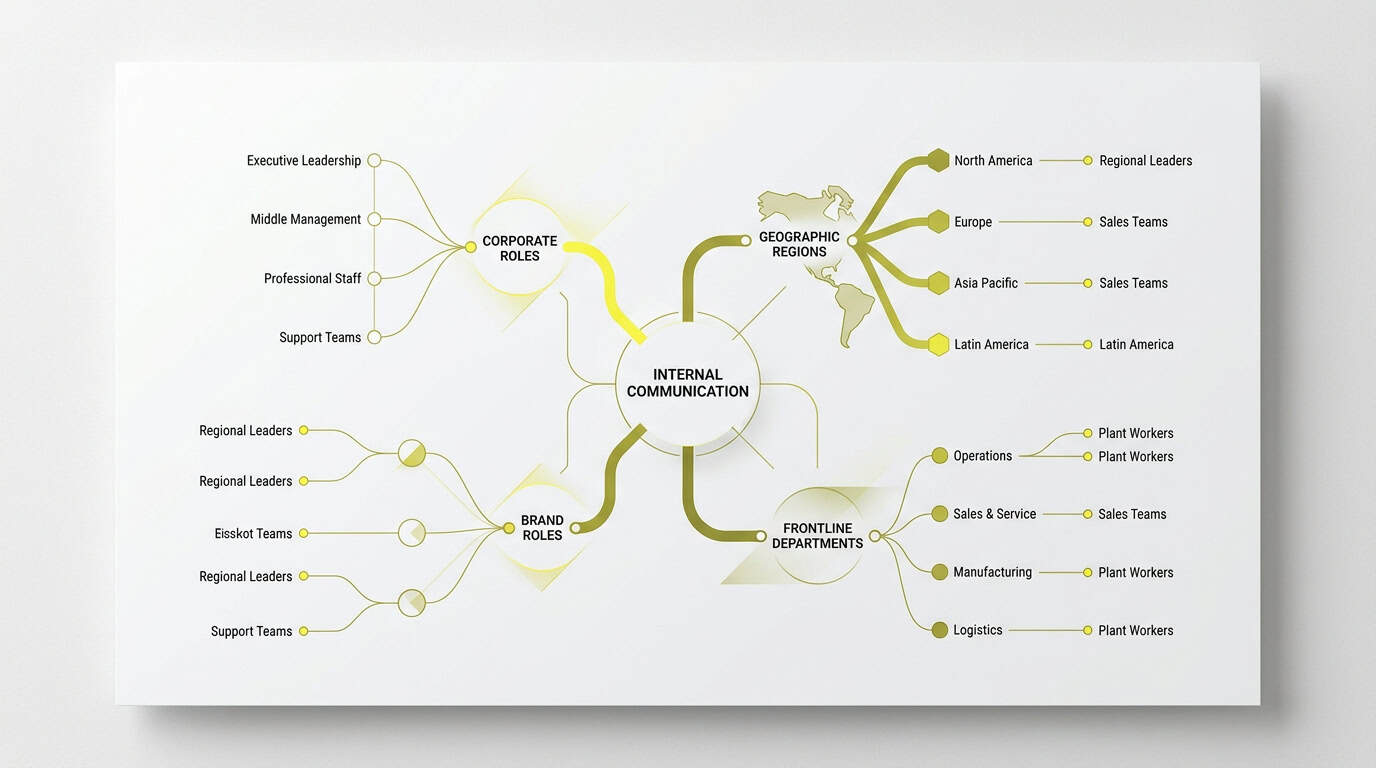
Filtering by department, geography, and role
To verify message penetration, communication teams must analyse engagement across specific attributes such as department, geographic region, job role, and tenure. Segmenting data by organisational structure exposes whether critical updates are reaching field workers, customer-facing staff, or specific regional business units. This granularity enables communicators to adjust distribution channels dynamically when specific departments show low engagement.
Identifying gaps in frontline communication
Frontline employees and field personnel often experience severe communication gaps compared to desk-based corporate staff. Without segmented analytics, organisations operate under the assumption that enterprise-wide announcements reach everyone equally. By tracking targeted penetration rates, internal communication leaders can identify isolated business units, deploy tailored communication methods, and ensure consistent alignment across all operational tiers.
Breaking data silos with cross-channel analytics
Modern digital workplaces rely on a multi-channel ecosystem comprising intranet portals, enterprise social networks, and internal email newsletters. However, managing separate reporting tools for each channel creates fragmented data silos. In Workvivo’s global survey of more than 5,200 communication professionals, only 36% of internal communications leaders rated engagement with internal comms as very high[4], a challenge exacerbated by disjointed channel measurement that prevents teams from seeing the complete employee journey.
The limitations of native Microsoft 365 reporting
Native analytics built into Microsoft 365 platforms provide useful basic metrics, but they operate in isolation. SharePoint Site Analytics displays page visits, Viva Engage reports on community activity, and email platforms track open rates. None of these native tools combine data to show whether an employee who ignored an email newsletter later read the same announcement on the intranet or joined the discussion on Viva Engage.
Combining intranet, social, and email data
Centralizing communication data across SharePoint, Viva Engage, and internal email newsletters reveals true holistic reach. An integrated analytics view eliminates duplicate counting and clarifies which channel combinations deliver maximum workforce engagement. By unifying cross-channel data into a single source of truth, internal communication leaders reduce reporting overhead while gaining actionable insights into multi-channel campaign effectiveness.
- Intranet Silos: SharePoint page analytics track visits but cannot link behaviour to email broadcast reads
- Social Silos: Viva Engage metrics monitor community posts without measuring formal news readership
- Email Silos: Newsletter reports show broadcast opens but fail to capture subsequent intranet policy downloads
Tracking message comprehension and behavioural impact
Confirming that an employee opened a document or loaded a web page does not prove that they absorbed the content or intend to act upon it. In her analysis of strategic communication measurement, Jenni Field emphasises that an email with a 90% open rate has failed if it does not drive the behaviour change it was intended to create[2]. Moving beyond visibility requires tracking message comprehension and measuring tangible post-communication actions.
Moving from outputs to verified behavioural outcomes
Evaluating behavioural impact involves monitoring what employees do after receiving a message. Did they submit the required compliance form? Did they enroll in the new benefits portal? Did helpdesk queries decrease following a system change announcement? By defining explicit action indicators for each internal campaign, communicators can measure genuine business outcomes rather than passive content consumption.
Connecting communication campaigns to operational efficiency
When internal campaigns successfully change workforce behaviour, the operational benefits ripple across the enterprise. For example, clear instructions during a software transition reduce IT support ticket volumes, while effective benefits communication increases self-service portal adoption. Tracking these post-communication behaviours provides concrete evidence that effective messaging improves operational efficiency and reduces organisational friction.
| Campaign Stage | Typical Output Focus | Verified Behavioural Impact Indicator |
|---|---|---|
| Information Broadcast | Email send count and open rate | Target audience survey comprehension score |
| Policy Implementation | Intranet page view total | Completed compliance sign-offs in HR portal |
| System Transformation | Announcement post impression count | Reduction in IT helpdesk clarification tickets |
Building an executive-ready reporting dashboard
Presenting communication data to executive leadership requires clear contextualization. Leadership attention does not follow click rates and views; it follows cost savings, efficiency, risk, and performance, as the contributors to Oak Engage’s credibility gap research stress[5]. Reporting that leans heavily on engagement statistics without spelling out the business implications makes communications look tactical rather than strategic. To build a compelling executive report that defends your budget, internal communication leaders must synthesize cross-channel metrics into concise, outcome-oriented dashboards.
Automating cross-channel insights for leadership
Manually gathering data from SharePoint, Viva Engage, and Outlook into monthly spreadsheets is time-consuming and prone to error. Dedicated cross-channel analytics platforms, such as Communication Insights by Tryane, automate data consolidation from across your Microsoft 365 ecosystem. By unifying email, intranet, and enterprise social metrics into streamlined dashboards, we help internal communication teams focus on strategic decision-making rather than manual data collection.
Defending your internal communication budget with confidence
Frequently asked questions
What are internal communication vanity metrics?
Vanity metrics are surface-level numbers, such as basic email open rates or intranet page views, that look impressive but fail to demonstrate true business impact. Executive leadership teams typically do not respond to these figures because they measure communication activity rather than organisational outcomes like alignment or behaviour change.
Why do executives care about internal communication metrics?
Executives need to ensure that the budget allocated to internal communication delivers a measurable return on investment. They rely on robust metrics to confirm that strategic initiatives, compliance updates, and change management programs are successfully reaching and influencing the workforce, thereby driving productivity and reducing risk.
How can I prove the ROI of internal communication to the C-suite?
To prove ROI, you must shift your focus from activity metrics to business outcomes. Track segmented audience reach and message comprehension, and link these indicators directly to executive priorities. Implementing an all-in-one analytics platform provides the hard data required to justify your budget.
Which internal communication metrics resonate most with leadership?
Leadership responds best to metrics that connect communication to the outcomes they own. These include deep audience segmentation to verify the message reached key departments, engagement trends that indicate strong corporate culture, and cross-channel performance data that illustrates operational efficiency. Workvivo’s global research found that 46% of internal communications leaders say their reporting fails to resonate with executives.
Why is cross-channel measurement important for reporting?
Employees consume information across multiple platforms, including SharePoint, Viva Engage, and email newsletters. Measuring performance on a single channel leaves blind spots and fragments your data. Cross-channel measurement centralises these insights, providing a holistic view of employee engagement that accurately reflects the full impact of your campaigns.
How does audience segmentation improve executive reporting?
Aggregate data hides critical insights. Audience segmentation allows you to filter metrics by department, country, or role, proving to the executive team that a crucial message successfully reached frontline workers or a specific regional office. This level of granularity transforms generic reach statistics into targeted, actionable business intelligence.
Sources
• oak.com
• internalcommsroi.workvivo.com
• pressreleases.responsesource.com
Further reading
• Measuring cross-channel internal communications
• Audience segmentation for internal communications
• The five internal communication KPIs that show your IC is working
• Measuring frontline worker communications
• How to prove internal communications works to leadership
• Building an internal communications measurement strategy
Tryane runs a 15-minute working session with Heads of Internal Communication, walking through your current measurement setup and showing where the segmentation gaps sit on your own Microsoft 365 tenant. Book a slot with Jérémy.