
In short
Stop relying on vanity metrics. Apply the AMEC Barcelona Principles V4.0 to your internal communication strategy to measure cross-channel engagement, prove business impact, and make data-driven decisions that the C-suite trusts.
Key takeaways
- The Barcelona Principles V4.0 require linking communication directly to organisational outcomes.
- Gallagher’s State of the Sector found KPI performance is the biggest factor separating high-performing comms teams from the rest.
- Move past vanity metrics like simple page views to measure segmented cross-channel reach.
- Internal communication measurement must prioritise transparent methodologies and strict data governance.
Set clear, measurable communication objectives
As internal communication leaders, we often face intense pressure to demonstrate strategic value to executive leadership. When campaigns launch without concrete goals, evaluation becomes a reactive exercise in gathering basic interaction counts. AMEC Principle 1 establishes that communication measurement must begin with explicit, outcome-focused goals tied to core business objectives. When you define your target outcomes prior to distribution, you ensure that every metric gathered serves a clear operational purpose rather than remaining an isolated figure.
To establish meaningful alignment, internal communication objectives must move beyond simple dissemination targets like publishing a weekly newsletter or launching an intranet announcement. AMEC launched the Barcelona Principles 4.0 on the first day of its global summit in Vienna in June 2025, an evolution rather than a revolution that sharpens the framework’s language for a technology-driven workplace. Principle 1 now states that setting clear, measurable objectives is a critical prerequisite for effective communication planning, measurement and evaluation. By establishing a baseline for internal communication KPIs, you create a structured roadmap that tracks awareness, comprehension, and subsequent employee behaviour across digital channels.
Define objectives across three strategic levels
Structuring clear objectives requires breaking goals into distinct performance tiers so leadership understands the full narrative behind campaign performance.
- Outgrowth and reach targets: Quantify the initial distribution scope, verifying that key messages reach intended employee segments across email, SharePoint, and enterprise social networks.
- Attitudinal and comprehension goals: Assess whether employees grasp executive messaging, process policy updates, or understand strategic shifts.
- Behavioural and business outcomes: Measure tangible organisational responses, such as open enrolment completions, policy sign-offs, or adoption of operational practices.
Integrating holistic KPI analysis across channels before launching campaigns ensures your team evaluates meaningful progress. When you establish clear benchmarks early, you can adapt your strategy in real time rather than discovering gaps after a campaign concludes.
Understand employee audiences as co-creators
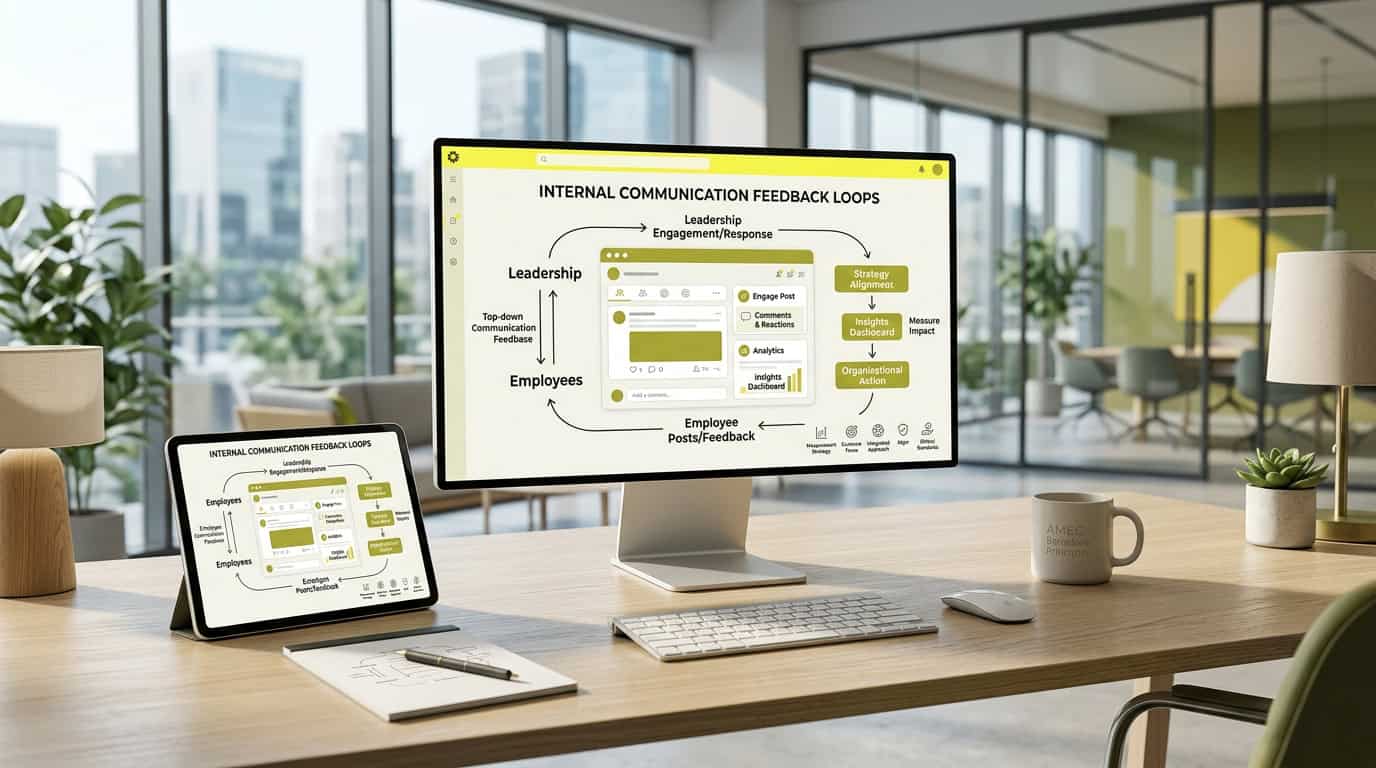
Traditional internal comms models treated workforce communication as a broadcast channel, where corporate leaders delivered messages to passive readers. AMEC Principle 2 requires a fundamental mindset shift, recognising that employees are active participants who shape, interpret, and amplify organisational culture. Viewing your workforce as co-creators transforms internal communication from a one-way noticeboard into an interactive operational network.
The global findings from Gallagher’s State of the Sector 2025 report, which gathered insights from 2,300 communicators worldwide, underscore the critical necessity of deeper employee experience insights[1]. Modern digital workplaces require channels that facilitate ongoing dialogue rather than top-down broadcasts. Moving toward two-way communication enables organisations to capture immediate workforce reactions, spot operational friction, and foster genuine engagement across dispersed teams.
Use enterprise social networks for interactive feedback
Analysing interaction patterns on Viva Engage offers insight into real-time employee sentiment and discussion topics. Rather than relying solely on official top-down announcements, tracking how workforce groups react to executive posts highlights immediate questions and concerns.
When employees actively comment, share, and discuss corporate updates, they provide qualitative signals about organisational health. By regularly analysing these conversational trends on Viva Engage, you gain the actionable insights needed to refine messaging clarity, address misunderstandings promptly, and make data-driven decisions that strengthen workplace trust.
Measure across all internal communication channels
Corporate communications rarely rely on a single channel to deliver vital news. Employees interact with information across email newsletters, SharePoint intranet sites, Microsoft Teams channels, and Viva Engage feeds. However, tracking these platforms in isolation creates fragmented data silos that obscure total campaign reach and confuse executive sponsors. AMEC Principle 3 mandates holistic measurement that captures the complete employee journey across every digital touchpoint.
Data from Gallagher’s State of the Sector report indicates that 55% of internal communicators fall into a “Striver” cohort that has made progress toward organisational purpose but still struggles to meet KPIs while navigating channel complexity and change fatigue[2]. Without cross-channel measurement, teams struggle to identify whether low engagement on one channel reflects widespread indifference or simply an audience preference for a different platform. Unifying channel data reveals true reach across all workforce segments.
Channel measurement matrix: native vs unified cross-channel
Comparing platform capabilities reveals why relying strictly on native administrative tools limits strategic evaluation.
| Measurement Capability | Native Platform Analytics | Unified Cross-Channel View |
|---|---|---|
| Audience Deduplication | Not supported (counts multi-channel readers multiple times) | Deduplicates unique employee reach across platforms |
| Cross-Channel Attribution | Isolated per channel (SharePoint vs Email vs Teams) | Consolidates individual employee journey metrics |
| Segmented HR Filtering | Basic site-level or group metrics | Deep filtering by department, tenure, region, and role |
| Executive Reporting | Fragmented platform-specific exports | Single executive-ready dashboard |
Breaking down data silos across Microsoft 365 environments gives your team a comprehensive view of how messages perform. When you consolidate email, intranet, and enterprise social metrics into one central perspective, you eliminate guesswork and maximise campaign efficacy across your entire organisation.
Balance quantitative data with qualitative context
Hard metrics like click-through rates, page views, and read counts reveal what content employees access, but they cannot explain why employees respond in specific ways. AMEC Principle 4 emphasises that measurement requires balancing quantitative data with qualitative context. Numbers show patterns of interaction, while employee feedback, sentiment analysis, and context uncover the underlying drivers behind those patterns.
Relying exclusively on quantitative data can lead to misleading conclusions. A high view count on a SharePoint policy update might indicate widespread compliance, or it could signal that employees find the documentation confusing and must reread it repeatedly. Principle 4 of the updated Barcelona Principles states plainly that effective measurement and evaluation of communication require qualitative and quantitative analysis, so evaluation reflects true employee understanding rather than raw traffic.
Combining quantitative and qualitative indicators
Blending metric streams enables internal comms leaders to build a full picture of workforce engagement and sentiment.
- Quantitative metrics: Track reach, unique readers, video completion rates, scroll depth, and interaction frequencies across digital channels.
- Qualitative signals: Gather pulse survey comments, focus group feedback, Viva Engage sentiment trends, and open-ended manager responses.
- Integrated analysis: Synthesize numerical reach patterns with textual feedback to evaluate overall campaign impact and workforce alignment.
Combining hard analytics with qualitative feedback provides actionable insights on reach while clarifying employee sentiment. This balanced approach empowers you to make confident, data-driven decisions that cultivate a healthy corporate culture.
Stop relying on internal vanity metrics
For years, internal communication reporting relied on superficial metrics such as total page loads, email send counts, or aggregate intranet visits. AMEC Principle 5 calls for the explicit rejection of invalid or misleading measures that fail to demonstrate actual business value. High page view totals often mask low reading time or complete disinterest among critical frontline teams, giving leadership a false sense of campaign success.
To prove real value to the CFO and executive team, internal communications directors must transition from basic activity counting to deep audience segmentation. Analysing performance by department, geographical region, operational role, or tenure reveals hidden information gaps that aggregate data obscures. Gallagher’s State of the Sector research points to a common gap behind weak reporting: a failure to connect communication performance metrics to business impact measures, with many communicators accountable for success indicators they do not actually track[3]. That makes demonstrated organisational value, not total content volume, the metric worth reporting.
Transitioning from vanity measures to strategic metrics
Replacing basic usage figures with outcome-oriented metrics provides operational clarity.
| Vanity Metric | Strategic Replacement Metric | Strategic Action Enabled |
|---|---|---|
| Total Intranet Page Views | Read Time & Segmented Scroll Depth | Identify whether target departments thoroughly read core updates |
| Newsletter Email Sends | Deduplicated Unique Reach by Location | Identify quiet regional offices receiving insufficient updates |
| Total Social Likes | Comment Sentiment & Manager Reshares | Measure authentic advocacy and active leadership alignment |
| Platform Logins | Active Monthly Engagement Rate | Optimise channel distribution based on actual workforce usage |
Rejecting invalid measures and focusing on segmented analytics empowers you to stop wasting time on vanity reporting. By presenting meaningful engagement patterns organised by role and department, you prove real ROI to executive leaders.
Report on outcomes and organisational impact
A fundamental distinction in the AMEC framework lies between communication outputs and communication outcomes. Outputs represent the activities your team executes, such as distributing newsletter campaigns, posting video updates, or hosting town hall events. Outcomes reflect the resulting changes in employee knowledge, attitude, and behaviour. AMEC Principle 6 focuses squarely on evaluating these broader organisational impacts.
Executive sponsors care about business results rather than production metrics. Principle 6 of the Barcelona Principles states that measurement and evaluation should report outputs, outcomes and impact related to the organisation and stakeholder audiences. In practice, that means executive reporting should show whether published information influenced employee behaviour, accelerated change adoption, or reduced operational risk. Proving that the right employees received the right message at the right moment builds credibility with executive decision-makers.
Measuring the progression from output to impact
Tracking campaign progression requires mapping how initial communication efforts translate into business outcomes.
Shifting your reporting focus to business outcomes provides a strong defence during corporate budget reviews. Demonstrating direct alignment between communication initiatives and organisational performance secures ongoing investment in internal comms programs.
Maintain ethical data governance and transparency
As internal analytics become more sophisticated, maintaining employee trust and upholding data privacy standards is paramount. Principle 7 closes the framework by stating that ethics, governance and transparency with data, methodologies and technology builds trust and drives learning, with a stronger emphasis in version 4.0 on AI usage, data integrity, and methodological transparency. The refresh explicitly reflects the rapid emergence of AI in both content production and measurement. Employees must trust that engagement tracking serves to improve communication efficiency and workplace experience rather than conduct intrusive workplace monitoring.
Ensuring complete compliance with international privacy regulations such as GDPR (or RGPD) requires transparent methodologies and safeguards. Modern analytics platforms must respect employee privacy by aggregating reporting, anonymizing individual tracking where appropriate, and maintaining strict security standards such as SOC2 compliance. An all-in-one measurement platform must prioritise data ethics to remain a trusted asset for both IT and corporate communications teams.
Choose a trusted partner for cross-channel analytics
We at Tryane build specialised analytics solutions that empower internal communication professionals to measure cross-channel impact while upholding strict data governance standards. Our specialised suite includes Communication Insights for unified cross-channel dashboards, Analytics for SharePoint for intranet optimisation, and Analytics for Viva Engage for enterprise social metrics.
By combining the Barcelona Principles with specialised analytics, you can elevate internal communication into a strategic, data-driven discipline that commands executive respect. If you are ready to break down data silos and demonstrate true ROI to leadership, book a slot with Jérémy to schedule your personalised demo today.
Frequently asked questions
What are the AMEC Barcelona Principles?
The AMEC Barcelona Principles are a global standard for communication measurement and evaluation. Originally launched in 2010 and updated to version 4.0 in 2025, they provide a strategic framework for tracking outputs, outcomes, and business impact.
How do the Barcelona Principles apply to internal communication?
While often associated with public relations, the framework perfectly fits internal communication. It guides professionals to move beyond basic email open rates and instead measure how internal campaigns drive employee behaviour change and align with company goals.
Why should internal communicators avoid vanity metrics?
Vanity metrics, such as unsegmented page views or simple delivery rates, show activity but fail to prove business value. The Barcelona Principles advise focusing on outcome-based data that reveals if the right message reached the right audience at the right time.
What is cross-channel measurement in internal communication?
Cross-channel measurement involves tracking employee engagement across your entire digital workplace, including SharePoint, Viva Engage, and email newsletters. This holistic KPI analysis breaks down data silos to provide a complete view of communication reach.
Why do communicators struggle with measuring impact?
Gallagher’s State of the Sector research identifies performance against KPIs as the biggest factor influencing internal comms success, and many teams consistently meet targets without exceeding them. Native dashboards often lack the cross-channel capabilities needed to connect employee engagement directly to organisational outcomes.
Sources
Further reading
• Measuring cross-channel internal communications
• Audience segmentation for internal communications
• The five internal communication KPIs that show your IC is working
• Measuring frontline worker communications
• How to prove internal communications works to leadership
• Building an internal communications measurement strategy
Tryane runs a 15-minute working session with Heads of Internal Communication, walking through your current measurement setup and showing where the segmentation gaps sit on your own Microsoft 365 tenant. Book a slot with Jérémy.