
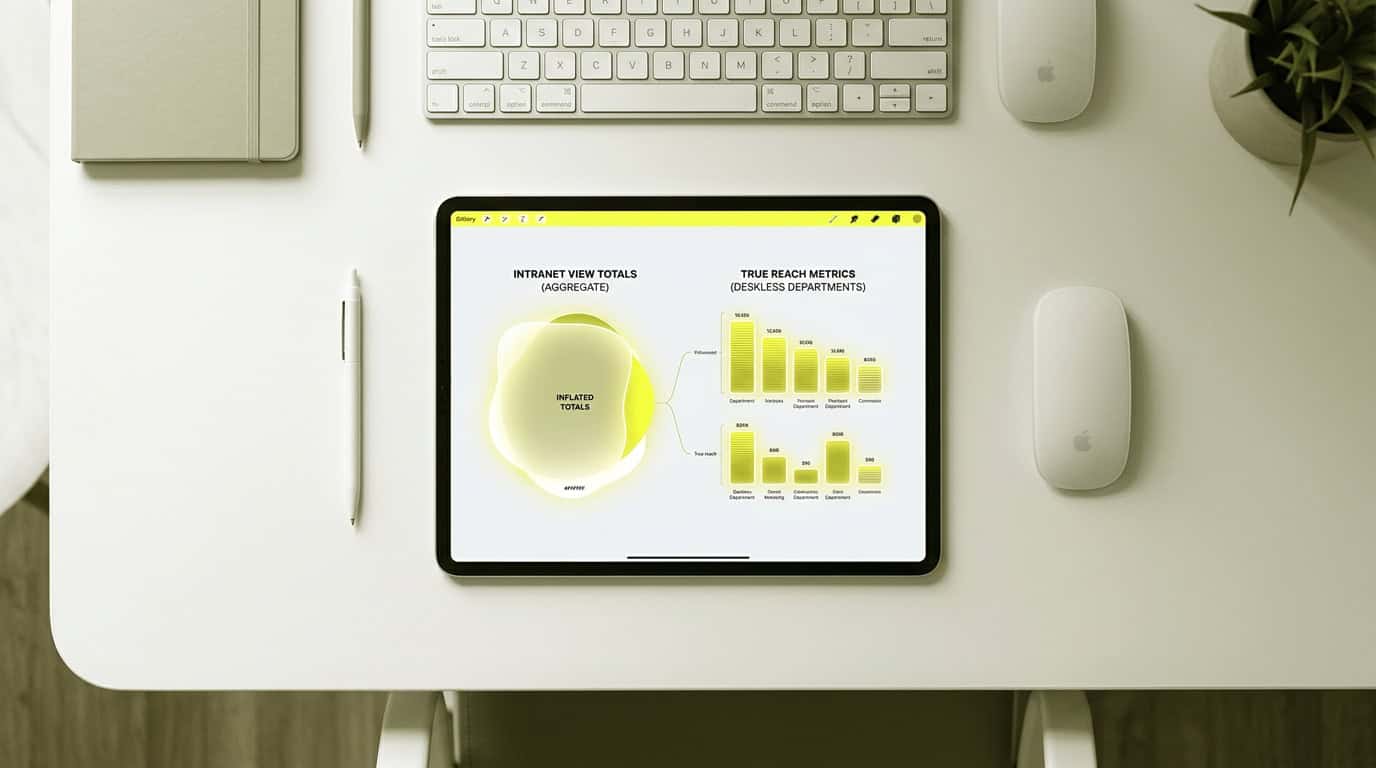
Discover why 80% of the workforce is deskless and how cross-channel analytics and audience segmentation help measure and close the engagement gap.
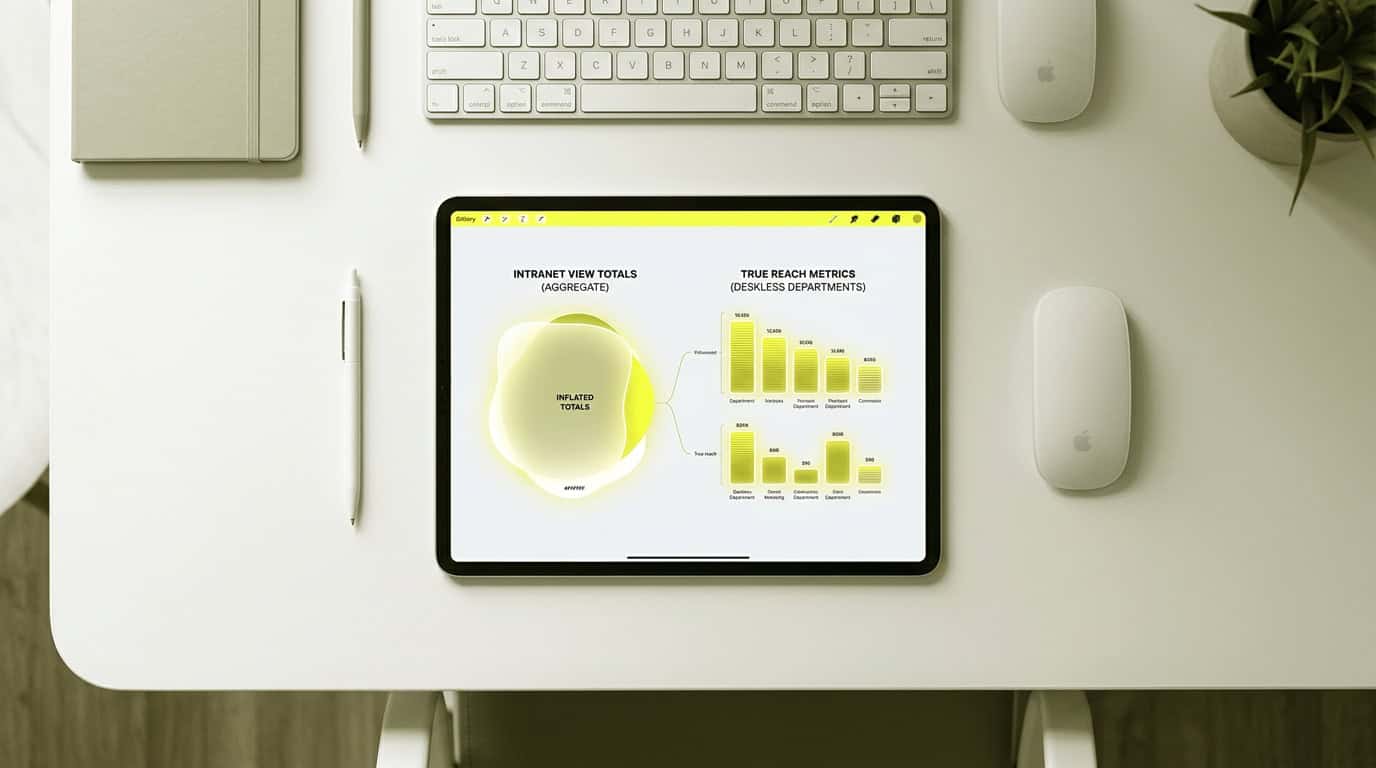
The deskless reality: understanding the engagement gap
In enterprise organizations across retail, manufacturing, logistics, and healthcare, a striking disconnect defines corporate communication. Deskless workers make up the large majority of the global workforce, yet internal communication strategies and measurement models remain almost exclusively designed for office-bound staff sitting behind desktop screens[1]. This structural divide leaves essential frontline teams isolated from leadership strategy, corporate updates, and cultural initiatives.
The consequences of this divide are visible in daily operations. Corporate news still travels mainly through email and intranets built for desk-based employees, so deskless staff end up relying on face-to-face relays to stay informed, and that gap breeds a sense of isolation from the organization’s goals and culture[1]. When the majority of employees operate outside the traditional intranet loop, sending announcements without targeted tracking creates a dangerous operational black box for executive leadership.
For internal communications leaders, managing frontline worker communications requires moving beyond unverified broadcasts. You cannot optimize engagement across factory floors, retail locations, or field operations if your analytics tools fail to show whether your messages land with non-desk personnel.
- Information isolation: Frontline staff rely on shift managers or physical bulletin boards, missing real-time executive announcements.
- Digital tool mismatch: Corporate communication tools often require enterprise email licenses that deskless personnel are never assigned.
- Measurement opacity: High-level campaign metrics obscure zero-engagement pockets in operational units.
Understanding this deskless engagement gap is the first step toward building an inclusive communication strategy that connects every employee to your organization’s mission.
Why native Microsoft 365 analytics fall short for the frontline
Most enterprise communicators rely on the built-in reporting features provided within their Microsoft 365 tenant. While native dashboards provide basic operational activity counts, they fail to answer the primary question senior leadership asks: did our message reach the operational teams who needed it most?
SharePoint native analytics offers site-level page view totals and unique visitor counts, but it cannot segment user traffic by HRIS attributes such as job role, department, country, or shift pattern without external tooling. A post announcing a safety protocol update might rack up thousands of page views, but native reporting cannot tell you whether those views came from headquarters staff in marketing or frontline technicians on the plant floor. Dedicated tools like Analytics for SharePoint solve this visibility issue by enriching raw usage events with organisational metadata.
Similarly, Viva Engage native analytics provides community-level interaction statistics but lacks cross-channel reach metrics that combine social conversations with intranet or email campaign data. Relying on standalone dashboards like Analytics for Viva Engage yields deep community insights, but evaluating overall frontline connection demands a broader, cross-channel perspective.
| Analytics Layer | Page View & Visit Totals | HRIS Role & Location Filtering | Cross-Channel Reach Linkage |
|---|---|---|---|
| SharePoint Native Analytics | Included | Not Available | Not Available |
| Viva Engage Native Analytics | Included | Not Available | Not Available |
| Cross-Channel Analytics Layer | Included | Included | Included |
Relying solely on native metrics creates a false sense of reach, encouraging communicators to mistake high aggregate view counts for meaningful frontline engagement.
The benchmark nobody publishes: tracking true reach
Standard internal communication benchmarks across industries frequently focus on global open rates or aggregate site visits. However, these published figures hide an uncomfortable reality: high head-office engagement inflates total averages, masking complete quiet among frontline populations.
To evaluate communication effectiveness across distributed workforces, internal communication directors must shift from aggregate page views to true reach metrics. True reach measures the exact percentage of a targeted audience group that has actually consumed and interacted with a specific piece of content within a given timeframe.
When you measure true reach rather than surface-level clicks, you instantly identify which plant locations, retail regions, or operational shifts remain disconnected. This clarity enables your team to adjust delivery channels, refine timing, and ensure critical business information reaches every corner of the enterprise.
Closing the gap: why audience segmentation is non-negotiable
Proving the value of internal communication to C-suite executives requires moving past top-level numbers. Implementing structured audience segmentation transforms disconnected interaction data into strategic business intelligence.
By filtering communication analytics through active employee attributes like job role, location, business unit, and tenure, communicators can evaluate campaign performance with surgical precision. Instead of assuming an enterprise update succeeded because total reads look high, segmentation reveals whether key frontline demographics opened, read, or ignored the message.
- Role-based filtering: Separate desk-bound administrative staff from non-desk field workers to evaluate channel preference.
- Geographic breakdown: Compare readership across regional hubs, plants, and retail outlets to spot local communication breakdowns.
- Tenure analysis: Track how newly onboarded frontline employees absorb compliance and cultural messages compared to veteran staff.
Tailoring communications based on segmented insights prevents message fatigue, reduces digital clutter, and ensures that frontline workers receive information that is directly relevant to their daily responsibilities.
Connecting the channels: email, SharePoint, and Viva Engage
Frontline employees rarely consume information through a single corporate channel. A retail associate might scan an email newsletter on a mobile device during a shift, check a quick announcement on Viva Engage, or access policy documents on SharePoint during training.
Single-channel analytics provide a fragmented picture of employee experience. Conducting cross-channel measurement allows communicators to consolidate activity streams across email, intranet portals, and enterprise social networks into a unified dashboard.
| Communication Channel | Primary Frontline Touchpoint | Analytics Challenge | Unified Insight Value |
|---|---|---|---|
| Internal Email Newsletters | Mobile device shift updates | Unread emails on shared accounts | Deduplicated open & click reach |
| SharePoint Intranet | Policy updates & store operational guides | Lack of native HRIS role tagging | Segmented page consumption |
| Viva Engage Communities | Peer support & leadership Q&A | Siloed community interaction data | Cross-channel social sentiment |
Platforms like Communication Insights combine these distinct telemetry streams into a single engagement view. This deduplicated cross-channel perspective reveals how employees interact across platforms, ensuring your messages hit their mark regardless of where staff log in.
The business case: linking communication to retention
Internal communication is consistently recognized as a primary driver of overall employee engagement in Gallagher’s State of the Sector report. Yet, according to Gallup’s State of the Global Workplace research, only 23% of employees globally are engaged at work. Bridging this gap on the frontline directly influences organizational retention and operational resilience.
Poor communication carries measurable financial and human costs. Research from Axios HQ shows that 60% of employees report digital communication increased burnout, and nearly half say ineffective workplace communication hurt their productivity[2]. In high-turnover environments like manufacturing or logistics, failing to inform and connect deskless workers accelerates voluntary turnover.
Conversely, establishing targeted frontline communication generates dramatic retention gains. In a case study published by Speakap, industrial equipment manufacturer STULZ USA cut its turnover to 10% after closing its frontline experience gap[3]. By substituting physical bulletin boards with direct mobile communication, they ensured deskless teams remained connected to company culture and operational priorities.
- Reduced attrition: Transparent leadership updates decrease early frontline exit rates.
- Increased operational safety: Real-time policy delivery cuts safety errors and protocol breaches on production lines.
- Stronger organizational alignment: Connected employees report higher trust in executive leadership decision-making.
Actionable steps to measure and optimize your impact
Upgrading your internal communication measurement strategy does not require heavy custom engineering or manual spreadsheet maintenance. By taking structured steps, internal communication leaders can turn unverified broadcasts into a data-driven engagement framework.
- Audit current channel reach: Identify where your frontline workers currently consume news and map existing coverage gaps.
- Eliminate manual spreadsheet assembly: Replace disconnected native exports with a centralized, automated analytics platform.
- Integrate HRIS metadata: Connect analytics with organizational attributes to unlock true role and location segmentation.
- Establish executive KPI reporting: Track true reach, audience sentiment, and cross-channel trends to demonstrate tangible ROI.
At Tryane, our mission is to empower internal communication professionals like you with actionable insights that prove the business impact of your work. Stop relying on unverified estimates and vanity metrics to guide your strategy.
Ready to close your organization’s deskless engagement gap? Schedule a consultation call with Jérémy today to explore how our all-in-one cross-channel analytics platform can transform your internal communications.
Frequently asked questions
Who are deskless workers?
Deskless workers are frontline employees who do not sit at a desk or use a corporate computer to perform their daily tasks. They represent an estimated 70% to 80% of the global workforce and include retail associates, factory workers, and healthcare professionals.
Why is measuring deskless employee engagement difficult?
Many frontline workers lack regular access to corporate intranets, and native analytics tools often fail to segment audiences by role or location. This leaves internal communicators guessing whether their messages reached the operational teams.
Can SharePoint native analytics track frontline workers?
SharePoint tracks overall page views and unique visitors, but out-of-the-box, it cannot segment this data by specific HRIS attributes like job function or country without external tooling.
How does audience segmentation improve internal communication?
By filtering engagement data by department or role, you can see exactly which parts of the organization received your message. This actionable insight allows you to adapt your strategy and stop sending irrelevant updates.
What is cross-channel reach?
Cross-channel reach is a metric that combines engagement data across multiple platforms, such as SharePoint, Viva Engage, and email, to calculate the true percentage of targeted employees who consumed a message.
How does communication impact frontline turnover?
Effective communication reduces isolation and burnout. Research shows that deskless workers who are dissatisfied with leadership communication are more likely to feel burned out, while targeted communication can significantly drop turnover rates