En bref
En 2026, la communication interne devient une fonction stratégique pilotée par la donnée, portée par l’IA, les formats vidéo et la collaboration hybride. Découvrez comment les équipes de communication interne modernes s’appuient sur l’analyse multicanale pour prouver leur ROI, préserver le bien-être des collaborateurs et stimuler l’engagement.
À retenir
- 84 % des communicants internes veulent mesurer davantage leur impact, et les dirigeants attendent de plus en plus que la communication interne rende compte de ses résultats en termes business concrets
- Les intranets sociaux et les environnements de travail numériques unifiés peuvent augmenter la rétention des collaborateurs jusqu’à 87 %
- Plus de la moitié des professionnels de la communication interne utilisent désormais l’IA au moins une fois par semaine, et une proportion similaire constate des gains d’efficacité significatifs
La communication interne: un levier stratégique en pleine évolution
Ce guide complet, publié initialement en janvier 2024 et mis à jour en août 2026 par Nicolas Saliba, analyse comment la communication interne est passée d’une fonction de support tactique à un levier stratégique essentiel pour l’entreprise. Pendant des décennies, les équipes de communication ont surtout été considérées comme des canaux de diffusion chargés de relayer les annonces descendantes, de mettre en forme les newsletters et de publier les notes d’information. Aujourd’hui, la direction attend de la communication interne qu’elle soutienne directement l’alignement de l’organisation, la transformation culturelle et la performance de l’entreprise.
Selon une étude sectorielle publiée par Gallagher, 84 % des communicants internes veulent mesurer davantage leur impact, et les communicants stratégiques qui alignent leurs initiatives sur les grands objectifs de l’entreprise ont nettement plus de chances d’obtenir des résultats business concrets. À mesure que les organisations deviennent plus distribuées, votre rôle exige de dépasser le simple volume de contenus pour vous concentrer sur la compréhension par l’audience, l’évolution des comportements et la résonance stratégique auprès de l’ensemble des collaborateurs.
Passer de la production de contenus au conseil stratégique
Lorsque la communication interne fonctionne comme un simple guichet réactif, les messages sont envoyés dans le vide, sans visibilité claire sur qui les a consultés ni sur les actions qui ont suivi. Endosser un rôle de conseil stratégique implique de structurer un rôle de communication interne rigoureux, qui relie les objectifs des campagnes aux grandes étapes de l’entreprise, à la rétention des collaborateurs et aux initiatives de conduite du changement.
- Passer des volumes de vanité (nombre de publications envoyées) au suivi des résultats (compréhension des messages et alignement sur les objectifs business).
- Conseiller la direction sur la gouvernance des canaux, le rythme des messages et leur formulation selon les publics, plutôt que d’envoyer des e-mails de masse de dernière minute.
- Établir des repères clairs par unité opérationnelle, zone géographique et catégorie de collaborateurs pour détecter les lacunes de communication avant qu’elles n’affectent la productivité.
- Démontrer un retour sur investissement mesurable aux parties prenantes de la direction lors des revues budgétaires et stratégiques annuelles.
Pour mener cette transformation, les directeurs de la communication interne doivent s’appuyer sur des données solides plutôt que sur leur intuition. Lorsque vous exprimez la performance de la communication dans des termes que les comités de direction comprennent, vous protégez votre budget et faites de votre équipe un partenaire de croissance indispensable.
Plateformes de collaboration unifiée: pilier des tendances communication interne
L’essor rapide des modèles de travail distribué a fait des plateformes de collaboration la colonne vertébrale de l’environnement de travail numérique moderne. Les organisations ne s’appuient plus sur un canal unique et monolithique : les collaborateurs naviguent dans un écosystème à plusieurs niveaux composé d’intranets SharePoint, de canaux Microsoft Teams et de réseaux sociaux d’entreprise comme Viva Engage. Si cette diversité permet une connexion permanente, elle crée aussi une forte fragmentation des canaux lorsqu’elle n’est pas gouvernée.
Une étude citée par Haiilo montre que le déploiement d’un intranet social bien intégré peut entraîner une hausse de 20 % de la satisfaction des collaborateurs, ainsi qu’une hausse de 87 % de leur rétention, en supprimant les silos d’information et en favorisant la transparence[1]. Lorsque les outils de l’environnement de travail numérique s’intègrent naturellement aux processus quotidiens, les collaborateurs passent moins de temps à chercher une documentation fiable et davantage à s’impliquer dans les initiatives stratégiques de l’entreprise.
Trouver l’équilibre entre collaboration synchrone et asynchrone
Les stratégies de communication interne efficaces distinguent clairement les canaux de conversation en temps réel des référentiels structurés de contenus longs. S’appuyer exclusivement sur les fils de messagerie instantanée pour les annonces critiques de l’entreprise génère du bruit numérique, de la fatigue cognitive et des messages manqués. À l’inverse, cantonner les informations à des bibliothèques de documents statiques limite l’engagement bidirectionnel et les échanges entre pairs.
| Type de canal | Rôle principal dans l’environnement de travail | Point fort | Risque opérationnel fréquent |
|---|---|---|---|
| Intranet SharePoint | Source unique de vérité et gouvernance structurée | Actualités de l’entreprise centralisées et documents de référence officiels | Peu d’interactions spontanées en l’absence de fonctions sociales |
| Viva Engage | Réseau social d’entreprise et communautés | Dialogue bidirectionnel, reconnaissance entre pairs et visibilité des dirigeants | Attention dispersée sans animation ciblée des communautés |
| Microsoft Teams | Travail d’équipe synchrone et messagerie opérationnelle | Collaboration rapide et informations immédiates au sein des départements | Surcharge d’information et annonces noyées dans les fils de discussion |
Réunir ces environnements au sein d’une stratégie de canaux coordonnée garantit que les informations critiques atteignent chaque collaborateur dans son espace de travail de prédilection, sans surcharger son quotidien.
Communication interne et intelligence artificielle: un duo gagnant
L’intelligence artificielle est passée du statut de nouveauté expérimentale à celui d’assistant quotidien indispensable pour les professionnels de la communication. Plutôt que de remplacer le jugement humain, l’IA générative permet aux équipes de communication de produire plus vite des contenus de meilleure qualité, de résumer des rapports volumineux et d’adapter le ton des messages aux différents publics de l’entreprise. La véritable force de l’IA est de supprimer les tâches de rédaction répétitives, pour que les communicants puissent se concentrer sur la stratégie narrative de haut niveau.
Les benchmarks du secteur confirment que l’IA est passée de l’expérimentation à la routine : plus de la moitié des professionnels de la communication interne (52 %) utilisent désormais l’IA au moins plusieurs fois par semaine, et 53 % font état d’un impact très élevé ou significatif sur leur efficacité, notamment en stratégie de contenu, en planification et en stratégie de canaux[2]. En outre, les communicants qui utilisent déjà l’IA sont trois fois plus susceptibles de penser que la technologie réduira leur charge de travail, libérant des heures qu’ils peuvent consacrer à l’alignement stratégique des parties prenantes et à l’accompagnement des dirigeants[3].
Applications concrètes de l’IA dans les processus de communication interne
Intégrer des outils comme Copilot à votre processus éditorial permet de décliner rapidement une communication de référence en formats multicanaux. La transcription d’une seule réunion plénière peut être rapidement restructurée en un article d’intranet concis, une série de courtes publications pour Viva Engage et des éléments de langage sous forme de puces pour les managers.
- Rédaction et idéation : générer des premiers plans, des variantes de titres et des objets d’e-mail percutants adaptés à des groupes de collaborateurs précis.
- Ajustement du ton : transformer des notes techniques de la direction en textes clairs et empathiques, adaptés aux collaborateurs de terrain et sans poste de travail fixe.
- Localisation multilingue : accélérer la traduction et l’adaptation aux nuances culturelles pour des effectifs internationaux répartis dans différentes régions.
- Synthèse de contenus : condenser des politiques internes complexes ou des rapports financiers en résumés faciles à lire et en points clés visuels.
L’adoption de l’IA exige toutefois une gouvernance éditoriale claire. Préserver une confiance authentique des collaborateurs suppose une supervision humaine de tous les messages finaux, afin de garantir la cohérence de la voix de marque, le respect de l’éthique et l’exactitude des faits.
Le bien-être et l’inclusion au cœur de la stratégie de communication
À mesure que les environnements de travail numériques s’étendent, l’épuisement professionnel et la lassitude face aux messages sont devenus des risques critiques pour les organisations. Lorsque chaque département diffuse des alertes urgentes sur plusieurs canaux, les collaborateurs subissent une forte surcharge cognitive, qui entraîne désengagement et baisse de productivité. En 2026, les organisations les plus avancées font du bien-être des collaborateurs une priorité en instaurant un rythme de communication maîtrisé et des frontières délibérées entre les canaux.
Les équipes de communication doivent aussi donner aux managers les moyens de jouer pleinement leur rôle de relais essentiel. L’étude State of the Sector de Gallagher montre que 84 % des communicants s’appuient dans une certaine mesure sur les managers pour communiquer, mais que trois sur cinq estiment que la communication des managers est en deçà des attentes, et que les managers évalués sur leurs compétences en communication étaient deux fois plus nombreux à atteindre ou dépasser ces attentes[3]. Mettre à la disposition des managers des ressources dédiées accessibles à la demande, des éléments de langage structurés et des kits pratiques garantit que les messages stratégiques sont efficacement replacés dans le contexte des équipes locales.
Favoriser une inclusion réelle des collaborateurs de bureau comme de terrain
Une stratégie de communication réellement inclusive réduit la fracture numérique entre les collaborateurs travaillant sur un poste informatique et les équipes de terrain sans bureau de la logistique, de l’industrie et de la distribution. Lorsque les collaborateurs de terrain n’ont ni accès direct à la messagerie de l’entreprise ni portail adapté au mobile, ils se retrouvent déconnectés de la raison d’être de l’entreprise.
- Instaurer des plages sans communication et respecter les fuseaux horaires pour prévenir la fatigue numérique et l’anxiété liée aux alertes reçues hors des heures de travail.
- Diffuser des informations localisées et accessibles sur mobile via des intranets responsives et des communautés disponibles sur smartphone pour le personnel sans poste fixe.
- Fournir aux managers des kits concis contenant éléments de langage, FAQ et pistes de discussion avant les grandes annonces de l’entreprise.
- Créer des espaces sûrs et modérés pour les réseaux internes de collaborateurs et des boucles de feedback ouvertes, afin que chaque population de l’entreprise dispose d’une voix reconnue.
En intégrant l’empathie et un accompagnement structuré des managers à votre dispositif de communication, vous créez un environnement bienveillant qui renforce la fidélité des collaborateurs et la sécurité psychologique.
L’essor de la communication visuelle pour engager à distance
Avec une capacité d’attention qui diminue et une surcharge de texte à son comble dans les contextes de travail hybride, la communication visuelle est devenue essentielle pour capter l’attention. Les longs e-mails adressés à tous et les articles d’intranet trop denses sont souvent survolés, voire ignorés. À l’inverse, les vidéos courtes, les infographies et les formats visuels interactifs transmettent rapidement des messages complexes tout en créant un lien humain authentique entre des équipes distribuées.
Les données compilées par Unily montrent que 75 % des collaborateurs sont nettement plus enclins à regarder une vidéo qu’à lire un e-mail ou un document textuel, et que les formats visuels augmentent fortement la mémorisation de l’information et l’engagement du public[4]. Intégrer la vidéo aux messages des dirigeants humanise la communication de la direction et rend la stratégie de l’entreprise accessible et transparente.
Choisir le bon format visuel selon votre objectif
Une production haut de gamme n’est plus une condition préalable à une communication vidéo efficace. En réalité, les vidéos authentiques et informelles tournées sur smartphone ou enregistrées directement dans Microsoft Teams suscitent souvent plus de confiance et d’engagement que des productions de studio très soignées.
| Format visuel | Durée cible | Usage idéal | Conseil de production clé |
|---|---|---|---|
| Vidéo de briefing de la direction | 60 à 90 secondes | Résultats trimestriels, réorientations stratégiques et communication de crise | Adopter un ton conversationnel et direct, sans script |
| Infographie animée | Sans objet (support visuel) | Évolutions des avantages sociaux, changements de politique interne et schémas de processus | Utiliser une iconographie claire et des palettes de couleurs contrastées |
| Portrait et témoignage de collègue | 2 à 3 minutes | Reconnaissance des collaborateurs, initiatives culturelles et intégration des nouveaux arrivants | Mettre en avant la parole authentique des collaborateurs dans leur environnement de travail |
| Tutoriel de micro-learning | 1 à 2 minutes | Déploiements de systèmes, consignes de sécurité et bonnes pratiques d’utilisation des outils | Se concentrer sur un seul processus ou une seule action par vidéo |
Intégrer des contenus multimédias à vos actualités SharePoint et à vos fils Viva Engage redynamise les canaux numériques et augmente les taux d’interaction dans toutes les populations de collaborateurs.
Analyse de données et personnalisation: l’ère de la com intelligente
La diffusion uniforme n’est plus viable dans les grandes entreprises modernes et complexes. Les collaborateurs attendent de leurs expériences numériques au travail la même pertinence que celle qu’ils connaissent en tant que consommateurs. Diffuser des informations adaptées au site, au département, à l’ancienneté et à la langue garantit que chacun reçoit les informations essentielles à son rôle, sans devoir trier un bruit institutionnel qui ne le concerne pas.
Malgré la nécessité évidente d’une planification fondée sur les données, un important déficit d’analyse persiste dans le secteur. Une étude publiée par l’Institute for Public Relations indique que 69 % des organisations ne suivent ou ne mesurent que rarement, voire jamais, l’évolution des attitudes et des comportements des collaborateurs, et que 65 % mesurent rarement, voire jamais, la compréhension des messages clés par les collaborateurs, alors que l’usage de l’intranet (60 %) et la satisfaction ou l’engagement des collaborateurs (57 %) sont largement suivis[5]. Pour combler cet angle mort, il faut une stratégie de mesure mature, qui suit l’engagement dans la durée sur tous les points de contact numériques.
Faire progresser la maturité de votre mesure de la communication interne
Pour démontrer une valeur réelle aux parties prenantes de la direction, les communicants internes doivent passer des simples indicateurs de clics à une analyse multicanale approfondie.
- Niveau 1 : indicateurs d’activité (nombre de publications, de newsletters envoyées, d’événements programmés).
- Niveau 2 : portée et exposition (lecteurs uniques, taux d’ouverture, pages vues, vidéos regardées jusqu’au bout).
- Niveau 3 : engagement et sentiment (réactions, partages, commentaires qualitatifs, taux de participation aux communautés).
- Niveau 4 : impact et compréhension (mémorisation des messages, adoption des politiques internes, évolution du sentiment des collaborateurs et changements de comportement liés aux objectifs business).
En mettant en place une segmentation structurée et une analyse multicanale globale, vous transformez des données brutes en enseignements exploitables qui optimisent la performance de vos prochaines campagnes.
Optimiser le ROI multicanal avec Communication Insights
Fondé en 2008, Tryane Analytics a été conçu avec un objectif clair : donner aux professionnels de la communication interne des informations exploitables qui prouvent leur impact et orientent les décisions stratégiques. Aujourd’hui, plus de 1 500 organisations font confiance à Tryane pour mesurer et optimiser leur environnement de travail numérique sur Microsoft SharePoint, Viva Engage, Microsoft Teams et l’e-mail.
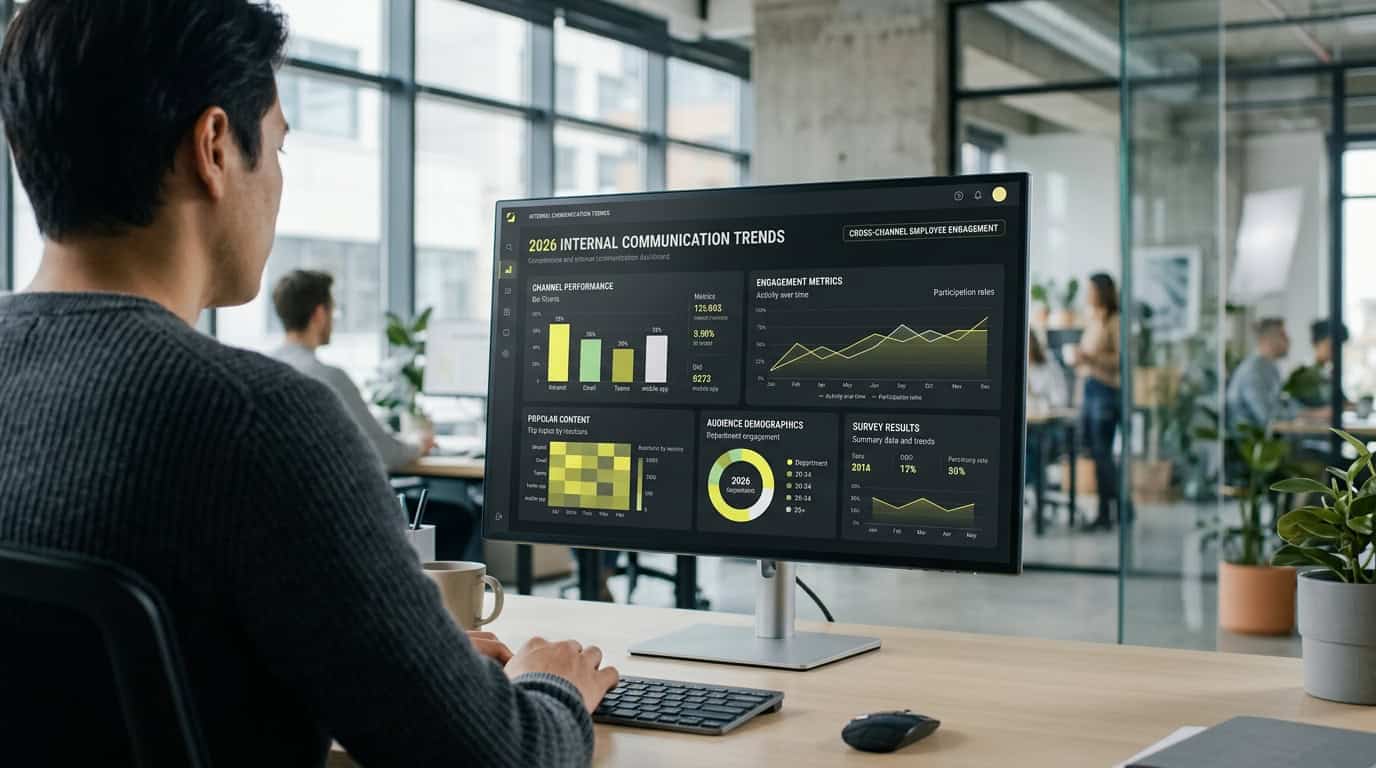
Communication Insights est une plateforme d’analyse multicanale tout-en-un de premier plan, qui centralise l’ensemble de votre écosystème de communication dans un tableau de bord prêt à être présenté à la direction. Au lieu de passer des heures à compiler manuellement des statistiques éparses issues de différents centres d’administration Microsoft 365, Communication Insights assure un suivi automatisé dans la durée qui révèle qui lit vos messages, dans quel département et sur quel canal.
Des fonctionnalités concrètes conçues pour les équipes de communication interne modernes
Communication Insights fournit aux directeurs de la communication des outils dédiés pour maximiser l’engagement des collaborateurs et éliminer les efforts inutiles dans l’environnement de travail numérique :
- Meilleur moment pour publier : des recommandations fondées sur les données qui identifient le jour et l’heure exacts où votre audience cible est la plus active, pour maximiser la visibilité et la lecture de vos messages.
- Détection des pages inactives : un audit automatisé qui repère les pages SharePoint obsolètes ou peu performantes, pour un intranet ordonné, pertinent et sécurisé.
- Segmentation d’audience multicanale : un filtrage approfondi par unité opérationnelle, zone géographique et fonction pour révéler les silos d’engagement et vérifier la portée auprès des collaborateurs de terrain.
- Rapports mensuels automatisés : des rapports PowerPoint personnalisables, prêts pour la direction et générés en quelques secondes, pour démontrer le ROI de la communication directement au comité exécutif.
Cessez d’envoyer vos messages dans une boîte noire. Un échange de 15 minutes avec Jérémy suffit pour passer en revue la façon dont votre communication interne est mesurée aujourd’hui et voir comment Communication Insights peut renforcer votre impact stratégique.
Questions fréquentes
Quelles sont les principales tendances de la communication interne en 2026 ?
Les grandes tendances de 2026 sont l’usage stratégique de l’IA générative, l’essor des formats vidéo, la priorité donnée au bien-être des collaborateurs en donnant aux managers les moyens d’agir, et l’exploitation de l’analyse de données multicanale pour hyperpersonnaliser les messages et prouver le ROI business.
Comment l’intelligence artificielle est-elle utilisée en communication interne ?
L’IA sert d’assistant quotidien pour la création de contenus, le brainstorming et la synthèse de données complexes. Selon le rapport State of Internal Communications 2026 de Simpplr, 52 % des professionnels de la communication interne utilisent l’IA au moins plusieurs fois par semaine et 53 % font état d’un impact très élevé ou significatif sur leur efficacité, ce qui libère du temps pour la stratégie et les nuances culturelles.
Pourquoi la communication managériale est-elle une tendance majeure en 2026 ?
Les managers restent une source majeure d’information sur l’organisation pour les collaborateurs. L’étude State of the Sector de Gallagher montre que 84 % des communicants s’appuient dans une certaine mesure sur les managers pour communiquer, mais que trois sur cinq jugent la communication des managers en deçà des attentes : c’est pourquoi les kits et l’accompagnement des managers sont devenus une priorité.
Une plateforme de collaboration unifiée peut-elle améliorer la rétention des collaborateurs ?
Oui. En réunissant des outils comme SharePoint, Microsoft Teams et Viva Engage dans un environnement de travail numérique unique, les entreprises simplifient l’expérience collaborateur. Des études montrent que le déploiement d’un intranet social peut augmenter la rétention des collaborateurs jusqu’à 87 %.
Pourquoi les communicants internes ont-ils du mal avec l’analyse de données ?
De nombreuses équipes de communication interne s’appuient sur des indicateurs fragmentés entre des plateformes isolées, et suivent de simples vues plutôt que la pénétration réelle auprès de l’audience. Une étude publiée par l’Institute for Public Relations montre que 69 % des organisations ne suivent ou ne mesurent que rarement, voire jamais, l’évolution des attitudes et des comportements des collaborateurs.
Sources
À lire également
• Les 5 KPIs de communication interne qui prouvent la valeur
• Comment mesurer l'engagement de vos collaborateurs
• Comment calculer le ROI de la communication interne
• Tableaux de bord pour la communication interne
Tryane propose une session de travail de 15 minutes avec les responsables de la communication interne pour passer en revue votre dispositif de mesure actuel et identifier les écarts de segmentation sur votre propre tenant Microsoft 365. Réservez un créneau avec Jérémy.